

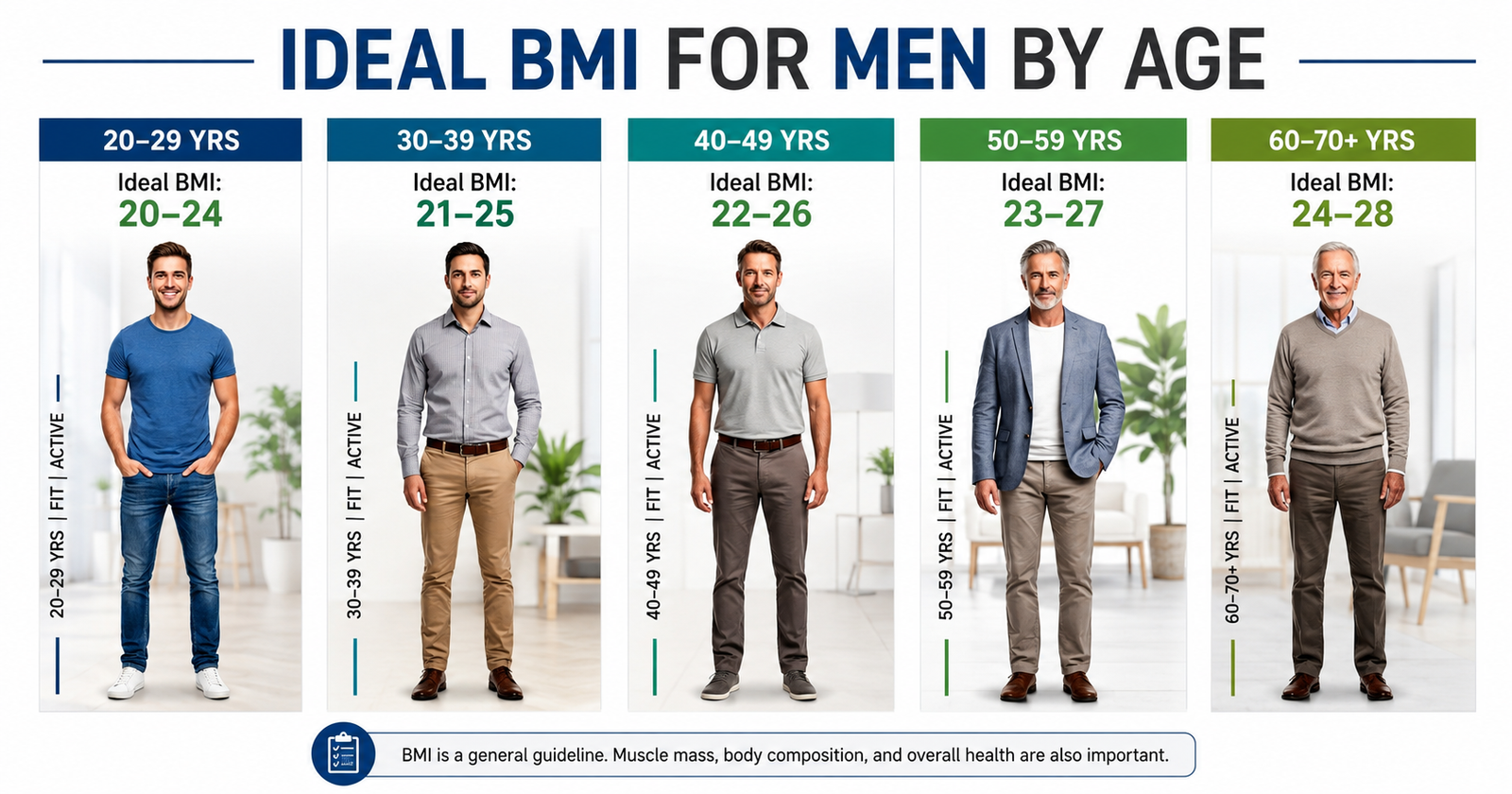
One of the most important elements in staying well long-term is knowing what a healthy body weight is. Among the various tools used to assess weight status, Body Mass Index (BMI) remains one of the most accepted and accessible indicators. BMI can be a helpful way for men to gauge whether they are within a healthy weight range, but it takes more than a formula to interpret it correctly. Age, lifestyle, muscle mass and metabolism changes all play a role in what “ideal” BMI actually means over time.
This comprehensive guide delves into the concept of ideal BMI for men by age, elucidates the mechanics of BMI, underscores its limitations, and offers practical insights into maintaining a healthy weight across various life stages.
What is a BMI and How Does It Work?
Body Mass Index ( BMI ) is a measure based on a person ‘s height and weight. It is calculated as weight in kilograms divided by height in metres squared. That number then classifies a person into a general category such as underweight, normal weight, overweight or obese.
BMI Categories for Men (General Guidelines)
- Underweight: Less than 18.5
- Normal weight: 18.5 – 24.9
- Overweight: 25-29.9
- Obese: 30+
These ranges are typical for adults, but they do not consider physiologic changes with age and therefore BMI should be interpreted in context.
Why is BMI important for men
BMI is a screening tool to identify potential health risks related to being underweight or overweight. Men with higher levels of BMI may be at greater risk of cardiovascular diseases, type 2 diabetes, high blood pressure and certain cancers. Very low BMI may be a sign of malnutrition, weakened immune system, or underlying health issues.
BMI, however, is not a direct measure of body fat. BMI may classify very muscular men (e.g., athletes) as overweight even though their body fat percentage is low. Thus, BMI should be used together with other health indicators.
Ideal BMI in the Context of Age
As men age, their natural body composition changes. You lose muscle mass . Your metabolism slows . Your fat distribution shifts . These changes imply that the “ideal” BMI range may vary slightly by age, even if the standard BMI categories remain the same.
Best BMI for Men in Their 20s
The 20s are typically the prime years of physical fitness and metabolic efficiency. Men tend to have more muscle and a faster metabolism at this stage, so it’s easier to stay at a healthy weight.
For men in their 20s, a normal standard BMI range is generally considered to be between 18.5 and 24.9. However, staying closer to the middle of this range is generally associated with optimal health outcomes. Men in this age group should also consider body fat percentage and not only BMI, as muscle mass is higher.
The habits you form during this period, such as regular exercise and healthy eating, are crucial for sustaining your weight in the long run.
Ideal BMI for Men in Their 30s
Around your 30s, your metabolism starts to shift, just a tiny bit. Many men gain weight from sedentary jobs, more responsibilities and less exercise.
The standard BMI ranges are still applicable, but a BMI between 20-25 is generally considered ideal. At this point, the quantity of physical activity is more important than the quality. Resistance training is particularly helpful in fighting the slow loss of muscle.
Men in their 30s also should pay more attention to diet quality as caloric needs will start to drop off slightly.
Best BMI for Men in Their 40s
The 40s are often characterised by significant metabolic slow down and hormonal shifts including a slow drop in testosterone levels. This may result in increased fat storage, particularly in the abdominal area.
For men in their 40s, the ideal BMI is still in the normal range, but it may be acceptable to have slightly higher values in this range. For example, a BMI of 23 to 26 could be healthy depending on your fitness and body composition.
At this stage, controlling stress levels, improving sleep quality and regular exercise become important in weight management.
The Perfect BMI for Men in Their 50s
Maintaining muscle mass becomes harder for men as they hit their 50s and the risk of chronic disease rises. Weight management is not about looking good but about staying healthy.
In this age group, a BMI of 23 to 27 for many men may be considered reasonable. But waist size and overall fitness are equally important.
Frequent health check-ups will be important, as BMI alone may not give the full picture of health risks.
Best BMI for Men Over 60
Slightly higher BMI values may actually be protective against some health conditions in older age. At this point a little excess weight is less dangerous than being underweight.
A BMI of 24 to 28 is often considered acceptable for men over the age of 60, provided there are no health complications. The primary goal becomes to maintain mobility, strength and independence.
The emphasis in nutrition should be on getting enough protein to avoid muscle loss, and the emphasis in physical activity should be on flexibility, balance and strength.
Limitations of BMI in Men
BMI is useful but there are several limitations of BMI that must be understood:
BMI does not distinguish between muscle and fat. Men with little body fat but a lot of muscle mass may have a high BMI.
BMI doesn’t tell you about fat distribution. The fat of the belly is more dangerous than the fat of the other parts of the body.
BMI doesn’t consider how body composition changes with age.
These limitations mean that BMI should be taken as a general guideline, not a definitive measure of health.
Other Metrics to Consider Besides BMI
So men should look at other ways of measurement to get a better picture of health not just BMI.
Waist circumference is a key marker of abdominal fat. A larger waist measurement is linked to increased health risks.
BMI alone is not a good indicator of composition, body fat percentage is better.
Waist-hip ratio is an indicator of the pattern of fat distribution.
Overall health is also affected by the level of fitness (strength, endurance, flexibility).
Factors that Determine ideal BMI in men
Several factors determine what BMI is ideal for an individual man.
Genes play a big role in determining our body structure and where we store fat.
Lifestyle habits such as diet, exercise, sleep, and stress management have a huge impact on weight.
Occupation and daily activity levels affect how many calories you burn.
Certain medical conditions and medications can affect metabolism and body weight.
Knowing these factors is important to set realistic and personalised BMI goals.
How to Maintain Your Ideal BMI at Any Age
A healthy BMI is attained through a balanced approach to diet, physical activity and lifestyle management.
Whole foods. Eating a nutrient-dense diet can help you control your weight and improve your health.
Regular exercise, such as aerobic activity and strength training, helps maintain muscle mass and control body fat.
Often overlooked but very important for weight control, getting enough sleep and coping with stress well are important.
It is more important to be consistent than to make short term efforts to maintain a healthy BMI.
Diet and BMI Control
Diet is one of the major factors to maintain the ideal BMI. Men should focus on eating balanced meals with proteins, healthy fats and complex carbs.
As we age, our caloric needs decrease and portion control takes on a greater significance. Cutting down on processed foods and added sugars can help you manage your weight far more effectively.
Hydration is also important as it supports metabolism and overall body functions.
The Significance of Exercise
Exercise is important for maintaining a healthy BMI as men get older. Cardio workouts help you burn calories and keep your heart healthy. Strength training helps preserve muscle mass.
In later years, exercises for flexibility and balance become more important to prevent injuries and maintain mobility.
But the key is to find a routine that is sustainable and fits individual preferences and lifestyle.
Mental Wellbeing and BMI
Good mental health is closely linked to good physical health. Stress, anxiety and depression can cause unhealthy eating behaviours and weight fluctuations.
Mindfulness, meditation and regular physical activity can all help with stress management and maintaining a healthy BMI.
Effective monitoring of BMI
Monitoring your BMI periodically can help identify trends and make adjustments as necessary. But that shouldn’t be the end of it.
Combining BMI measurement with other health indicators can provide a more comprehensive picture of overall health and well-being.
Benefits of Online BMI Calculators
Doing this by hand is a pain and can lead to errors. Online tools simplify the process and give you instant results.
Accurate BMI Tracking with Wideversa
Looking for an easy way to monitor your BMI? Wideversa has one of the best online BMI calculators out there. Their tool is designed to give you quick, accurate results that tell you where you’re at and what changes you may need to make.
Wideversa.com helps track your BMI regularly without any cost so you are informed and proactive about your health. Whatever your age, whether you’re in your 20s or your 60s, a reliable BMI calculator can make a big difference in helping you manage your weight effectively.
FAQ (Frequently Asked Question)
1. In general, what is the optimum BMI for men?
For men, the ideal BMI is typically between 18.5 and 24.9, though this may change slightly depending on age and body composition.
2. Is BMI age sensitive?
The formula for BMI is the same, but what is “ideal” can change a little bit as metabolism and muscle mass change.
3. Is BMI not reliable for muscular men?
For example, BMI can be misleading for very muscular men, as it cannot distinguish between muscle and fat.
4. How much is a dangerous BMI?
Generally, a BMI less than 18.5 or greater than 30 indicates an increased risk of health problems.
5. Is a higher body mass index better for older men?
Higher BMI values are acceptable in older men . Being underweight can be more dangerous .
6. How often should I take my BMI?
Most people only need to check their BMI every few months unless you are actively trying to manage your weight.
7. Can BMI tell you about your health?
While BMI can tell you about risk levels, it cannot diagnose specific health conditions.
8. What’s more important than BMI?
Body fat percentage, waist circumference and general fitness are often more indicative than BMI alone.
9. How to reduce my BMI?
Healthy eating, regular exercise, and lifestyle changes can help reduce BMI.
10. Is BMI useful for all?
BMI can be a helpful screening tool but should always be considered in conjunction with other health data for accuracy.
Conclusion
Great insight to maintaining long term health is knowing the ideal BMI for men by age. BMI is a useful starting point but should always be considered in conjunction with other factors such as body composition, lifestyle and overall fitness.
You can make tracking easier and stay on track with your health goals with trusted tools such as the free BMI calculator on Wideversa.com. Lastly, men can obtain and maintain an ideal BMI at any age by consistently tracking their progress and living a healthy lifestyle.
Summary
BMI is a popular tool for the assessment of weight status but needs to be interpreted differently at different ages. A man in his 20s or 30s should try to stay in the normal healthy range but a bit higher may be acceptable as a man gets older. But BMI alone isn’t enough to determine health as it doesn’t consider muscle mass or fat distribution.
To keep your BMI in a healthy range, you need to focus on all aspects of your lifestyle — your diet, your exercise, your mental well-being, and regular monitoring. Tools such as Wideversa’s online BMI calculator make it easier to monitor progress and stay informed. In the end, the goal of an ideal BMI isn’t perfection but the long-term maintenance of a balanced and healthy lifestyle.