

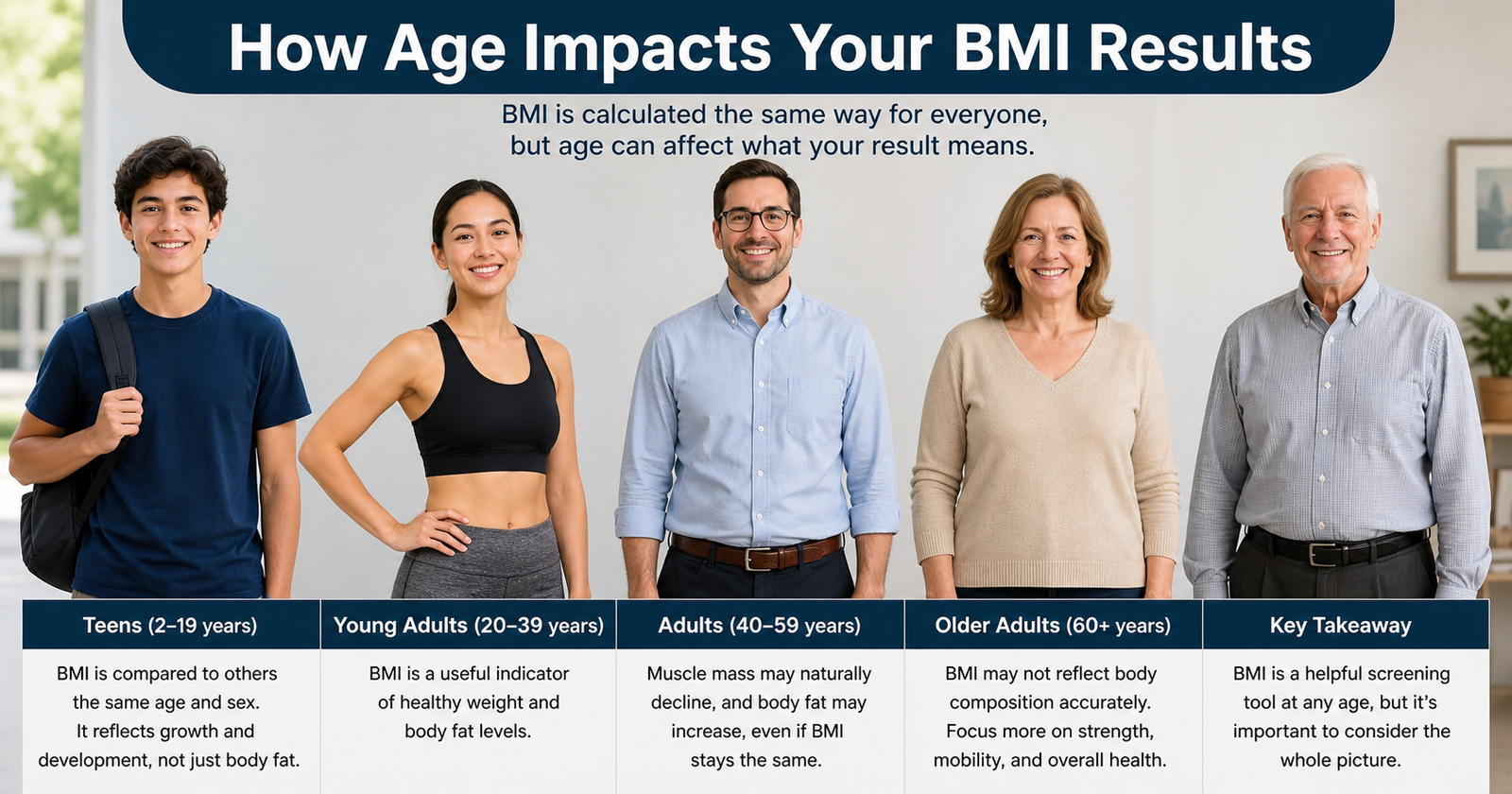
Body Mass Index or BMI as it is better known is one of the most common methods of determining if a person is within a healthy weight range. It is a simple calculation of height and weight but its interpretation is far more complex than many realise. BMI may be taken as a universal standard, but it doesn’t exist in a vacuum. One of the reasons this is misleading is because of age . The way BMI should be interpreted depends heavily on age.
The composition, metabolism and distribution of fat in the human body change with time. These changes will have a direct effect on how BMI is calculated and understood. Knowing how age impacts BMI results is important for making healthy choices for your fitness and long-term health.
In this article we take a deep dive into the age and BMI relationship, looking at how BMI changes across the course of a life and why a one size fits all approach does not always work.
What BMI Measures and What It Misses
BMI was calculated as weight in kilograms divided by the square of height in metres. This formula gives us a quick look at how much you weigh for your height . But it doesn’t tell us how much of that is muscle , fat , and bone .
This limitation is particularly relevant when age is considered. Even if your weight stays the same, your body composition changes as you age. You may lose muscle mass , gain fat mass and lose bone density . Such changes can profoundly influence what a BMI number actually means.
In younger people, BMI may be an indicator of growth and development. For adults, it often means weight categories like underweight, normal, overweight, or obese. But for older adults, BMI may not be the best measure of health risks because of changes in the body’s composition as we age.
BMI in Childhood and Adolescence
1. Growth and Development Patterns
BMI behaves very differently in children and teenagers compared to adults. These years are characterised by rapid body growth hormonal changes. Depending on where you are in your development, you grow taller, you gain muscle and your fat distribution changes.
That is why, for younger people, BMI is not interpreted in fixed categories, but is instead interpreted based on percentiles for age and gender . A normal BMI for a 16-year-old might be very different to that of a 10-year-old.
2. The Role of Puberty
There is a lot of variation in BMI in puberty. Hormones can change the way fat is distributed, especially for girls, and boys usually gain more muscle. These natural changes can cause changes in BMI that are not always connected to health issues.
3. Risks of Misinterpretation
False conclusions can arise if adult BMI standards are applied to children. A child may look overweight based on a simple BMI number, but be in a normal phase of development. That is why in the early stages of life it is so important to interpret age-specifically.
BMI in Early Adulthood
1. Stabilization of Body Composition
The body generally settles into a relatively stable state in early adulthood, typically between the ages of 18 and 35. Muscle mass is generally maximised, metabolism is working well, and hormonal balance is achieved.
During this time, BMI is often considered the best general marker for health. It is more strongly associated with body fat levels than other life stages.
2. Effect on Lifestyle
BMI may be more reliable in early adulthood, but lifestyle factors are important. Your body weight and composition can be affected by diet, exercise, sleep, and stress levels.
During this time many people start gaining weight slowly either due to sedentary lifestyles or changes in their routine. Small changes in BMI over time can signal shifts towards unhealthy patterns.
BMI in Middle Age
1. Slowing Metabolism
As we get older into our 40’s and 50’s, our metabolism naturally slows down. That means your body burns fewer calories at rest, making it easier to gain weight, even if the diet hasn’t changed much.
2. Muscle Loss and Fat Gain
One of the biggest changes in middle age is the gradual loss of muscle mass, called sarcopenia. Fat accumulation also tends to increase, particularly around the abdomen.
This change can lead to a higher BMI, even if the total weight change is small. Conversely, two people can have the same BMI but one may have a higher percentage of body fat, which raises health risks.
3. Hormonal Changes
Body composition is very sensitive to hormonal changes, especially in women going through menopause. These changes frequently lead to increased fat storage and different BMI readings.
4. Health Implications
As people get older, BMI is more strongly associated with chronic health conditions such as cardiovascular disease, diabetes and hypertension. Having said that, BMI should be interpreted along with other measures like waist circumference and fitness.
BMI in Older Adults
1. Changing Body Composition
BMI is not such a good measure of health for people over 60. Muscle loss speeds up, bone density goes down and fat distribution shifts.
Therefore, even an older adult with a “normal” BMI might have a higher percentage of body fat and less muscle mass that can impact mobility and overall health.
2. The Obesity Paradox
Interestingly , some studies have suggested that higher BMI levels in older adults may be associated with better survival rates . This phenomenon is commonly known as the “obesity paradox.”
Obesity still has its risks, but a bit of extra weight when you are older may be good for you, especially when sick or under stress.
3. Risk of Being Underweight
Having a low body weight can be more dangerous than being a little overweight in older people. Older adults with a low BMI are often frail, have weaker immune systems and are more prone to fall and break bones.
Why Age Matters in BMI Interpretation
1. One Size Does Not Fit All
BMI categories, such as underweight, normal, overweight, and obese, are based on data from the general population. They however do not take into account age specific physiological changes.
For a 25 year old, a BMI of 25 might be fine, but for a 70 year old, it could be something else. This distinction is important for accurate health assessment.
2. The Role of Body Composition
Muscle and fat changes with age affect BMI. Because BMI does not distinguish between these components, it can give a false impression of true health status.
3. Importance of Context
BMI should always be considered in the context of age, lifestyle and health. Ignoring these factors and simply looking at BMI can lead to incomplete or misleading conclusions.
How to Use BMI Effectively at Any Age
1. Combine BMI with Other Metrics
BMI should be used along with other measurements, like waist circumference, body fat percentage and physical fitness levels, to get a more accurate picture of health.
2. Focus on Trends Over Time
It is more useful to look at changes over time than to focus on a single BMI number. Gradual increases or decreases can give clues to health trends.
3. Adjust Expectations with Age
“Expectations should change with the body changes. The healthy BMI range for early adulthood may differ from that for later life. Knowing about these shifts can help set realistic and healthy goals.
The Role of Technology in Monitoring BMI
With the evolution of digital tools, keeping tabs on BMI is simpler than ever. People can easily calculate their BMI online and track it over time using online calculators.
Websites like wideversa.com provide simple-to-use solutions to calculate BMI accurately and efficiently. “Having tools like these can help people have a better understanding of where they are and how they may be affected by changes that come with aging.”
Why Regular Monitoring Matters
Regularly tracking BMI helps you see patterns that may not be visible right away. Weight changes are often gradual and early detection allows you to change your lifestyle in time.
Regular tracking also encourages accountability and awareness that are important to maintaining a healthy weight throughout all life stages.
Using Wideversa for Accurate BMI Insights
It is so much easier to know how age affects your BMI with a good, reliable tool. Wideversa is one of the best online BMI calculators. These calculators are designed to give quick and accurate results for users of all age groups.
People can calculate their BMI for free and determine how their age and body composition may be impacting the results by visiting wideversa.com. That makes it easier to take a more proactive approach to better health.
Conclusion
BMI is a useful measure, but it should not be the sole metric of health. Age is a crucial factor in determining how BMI should be interpreted. Every stage of life, from childhood development to age-related muscle loss, presents unique alterations that affect BMI readings.
Understanding these nuances helps people use BMI more effectively and avoid common misconceptions. It’s important to look beyond just the numbers and consider the wider picture of health, including lifestyle, fitness, and general wellbeing.
For accurate and convenient BMI tracking, wideversa.com is a great place to start.
FAQs
1. Is BMI affected by age naturally?
Yes, BMI can change with age, because your metabolism, muscle mass and where you carry fat can all change.
2. Does BMI apply to the elderly?
Because it does not take into account muscle loss and changes in body composition, BMI is less accurate for older adults.
3. Why are BMI standards different for children?
For children, age- and gender-specific BMI percentiles are used, as children are still growing and developing.
4. Can two people with the same BMI have different health conditions?
Yes, you can have the same BMI but different health outcomes due to body composition and lifestyle factors.
5. Does a high BMI always mean bad things in old age?
Not at all. “Sometimes, older adults with a slightly higher BMI may live longer.
6. How often should I check my BMI?
Generally, unless you are actively managing weight, it’s enough to check your BMI every few months.
7. Does BMI consider muscle mass?
Yes, higher muscle mass can lead to a higher BMI, even without excess body fat.
8. Can we use BMI as the only health guide?
No, BMI should be used with other health indicators to get the complete picture.
9. What is the effect of metabolism on BMI over time?
With age, a slower metabolism can lead to weight gain, resulting in a higher BMI.
10. Where can I easily calculate my BMI?
You can use the free tool on wideversa.com to calculate your BMI quickly and accurately.
Summary
BMI is a useful, but limited tool for assessing body weight and health. It becomes more complicated to interpret when age is factored in. The human body changes dramatically from childhood to old age and these changes affect the results of BMI.
In your younger years BMI is more a measure of growth and development and in your adult years, more a measure of body fat. As we age, the redistribution of fat and the loss of muscle make BMI less precise and require more context to interpret accurately.
Knowing the impact of age on BMI can help people make smarter health choices and avoid common misconceptions. when BMI is combined with other health measurements and reliable tools like the one offered on wideversa.