

One of the most important things you can do for your long-term health is to keep a healthy weight. Body Mass Index (BMI) is still one of the most common ways to check if your weight is in a healthy range. BMI itself doesn’t change with age, but how you understand and use it can change a lot at different points in your life. Your body changes in different ways as you age, which affects how it stores fat, builds muscle, and reacts to your lifestyle habits.
Knowing what a healthy BMI looks like at different times in your life can help you make better choices about your health, fitness, and diet. This in-depth guide talks about how to deal with BMI in your 20s, 30s, 40s, and beyond, and it gives you useful tips on how to keep a healthy balance for the rest of your life.
Understanding BMI and Its Role in Health
The Body Mass Index (BMI) is a simple formula that uses your height and weight. It gives a number that puts people into one of four groups: underweight, normal weight, overweight, or obese. It doesn’t directly measure body fat percentage, but it can be a useful way to find out about possible health risks.
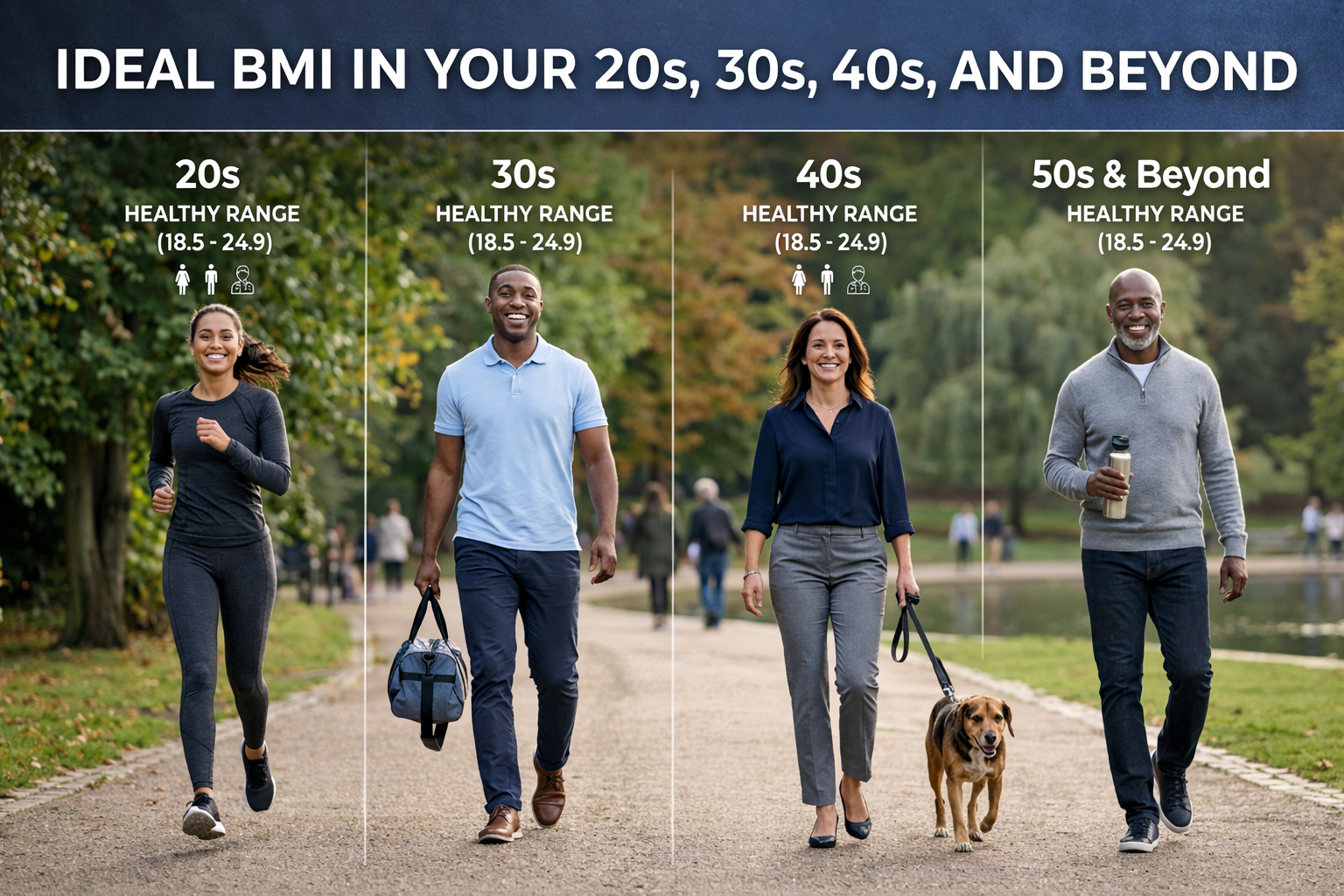
The general BMI categories stay the same no matter how old you are. A BMI of 18.5 to 24.9 is thought to be normal or healthy. But how your body works within that range can be very different depending on your age, lifestyle, and metabolic health.
As you get older, things like your muscle mass, hormone levels, and metabolic rate start to change. This means that even if your BMI stays the same, your body composition and health may not.
Ideal BMI in Your 20s: Building the Foundation
Many people think that your 20s are the best time for your physical health. During this time, your metabolism is usually at its highest, which means your body burns calories and builds muscle more effectively.
1. Metabolism and Muscle Mass in Your 20s
When you are in your early 20s, your basal metabolic rate is higher, which means you burn calories more efficiently even when you are not doing anything. It’s also easier to keep and build muscle mass, which helps you get a leaner body.
A BMI in the normal range for people in their 20s usually means that they have a healthy amount of fat and muscle. But this is also the time when bad habits can start to form. Your BMI can slowly change because of things like not getting enough exercise, eating the wrong foods, and not getting enough sleep.
2. Why BMI Matters in Your 20s
Keeping your BMI in the healthy range in your 20s is good for your long-term health. It lowers the chance of getting chronic diseases later in life, such as diabetes, heart disease, and metabolic disorders.
At this point, it’s important to focus on more than just BMI. It’s also important to build habits that will last. To stay at a healthy weight, you need to exercise regularly, eat a balanced diet, and learn how to deal with stress.
Ideal BMI in Your 30s: Managing Subtle Changes
Your body starts to change in small but noticeable ways when you turn 30. Your metabolism slows down, so it may be harder to keep the same weight as you did in your 20s.
1. Hormonal Shifts and Weight Gain
Changes in hormones, especially in women, can change how fat is spread throughout the body. Men may also see their testosterone levels slowly drop over time, which can affect how much muscle they have.
Even if your BMI stays in the normal range, these changes can cause your body fat to go up a little bit. This is why body composition becomes more and more important this decade.
2. Lifestyle Pressures and BMI
In your 30s, you often have more responsibilities, like getting ahead in your career and taking care of your family. These things can make it harder to take care of yourself and be active.
It takes work to keep your BMI at the right level during this time. It’s important to exercise regularly, eat mindfully, and stick to a routine.
3. Interpreting BMI in Your 30s
The ideal BMI range stays the same, but people in their 30s should pay more attention to their waist size and how fat is spread out. Even if your BMI is normal, having more fat around your stomach can still be bad for your health.
Ideal BMI in Your 40s: Navigating Midlife Changes
Your 40s are a time when your body changes more noticeably. The metabolism slows down even more, and the muscle mass starts to go down more quickly.
1. Decline in Muscle Mass
Sarcopenia, or the slow loss of muscle mass, is one of the biggest changes that happen in your 40s. Even if your weight stays the same, this can cause your body fat to go up.
This change can make it harder to keep a healthy BMI because muscle burns more calories than fat.
2. Increased Risk of Health Conditions
At this point, the chances of getting high blood pressure, cholesterol problems, and type 2 diabetes go up. Keeping a healthy BMI is even more important for lowering these risks.
3. Adjusting Your Approach to BMI
In your 40s, BMI alone may not be enough. To keep your muscle mass, strength training is very important. A balanced diet also helps you control your weight.
A normal BMI is still the best, but you should also have healthy habits and see a doctor regularly.
Ideal BMI in Your 50s and Beyond: Prioritizing Longevity
As you get older, it’s still important to keep a healthy BMI, but the way you do it changes.
1. Changes in Body Composition
As people get older, their body fat percentage goes up and their muscle mass goes down. Even if your BMI is normal, you could still be more likely to become weak or frail.
2. The Importance of Stability
Instead of trying to lose weight, the goal in later years is often to keep a healthy and stable weight. Sometimes, losing weight quickly can mean that you have health problems.
3. BMI and Aging Gracefully
A BMI that is a little higher than normal or mildly overweight may not be bad for older adults, especially if they are in good shape and health overall.
Factors That Influence Ideal BMI Across All Ages
Age is an important factor, but there are other things that affect what a person’s ideal BMI looks like.
1. Genetics and Body Type
How your body stores fat and builds muscle can be affected by your genes. Some people naturally have a higher or lower BMI without it having a big effect on their health.
2. Physical Activity Levels
Regular exercise helps keep your muscles strong and your metabolism healthy. People who are active may have a higher BMI because they have more muscle, which isn’t always bad for their health.
3. Food and Nutrition
Eating a balanced diet full of nutrients is good for your health and helps you keep your BMI at a healthy level. Bad eating habits can make you gain weight and put your health at risk.
4. Mental and Emotional Well-Being
Stress, anxiety, and emotional health can have a big effect on how much you eat and how much you exercise. Taking care of your mental health is an important part of keeping your BMI healthy.
Why BMI Alone Is Not Enough
BMI is a good way to check your health, but it doesn’t tell you everything you need to know. It doesn’t take into account muscle mass, bone density, or how fat is spread out.
For instance, athletes may have a higher BMI because they have more muscle mass, while people with a normal BMI may still have too much body fat.
Because of this, BMI should not be the only thing you look at. You should also look at your waist size, body fat percentage, and overall fitness level.
Practical Tips to Maintain an Ideal BMI at Any Age
To keep a healthy BMI, you need to make a mix of regular habits and careful decisions. To help keep a healthy weight, you should do cardio and strength training on a regular basis.
Your body needs a balanced diet with whole foods, lean proteins, healthy fats, and complex carbohydrates to work at its best.
People often forget about sleep and stress management, but they are very important for keeping your weight in check. Hormones that control hunger can be thrown off by not getting enough sleep, and long-term stress can make you eat in unhealthy ways.
Using Technology to Track Your BMI
It’s easier than ever to keep track of your BMI now that digital tools are getting better. You can keep track of your progress over time with online calculators that give you quick and accurate results.
WideVersa has one of the best online BMI calculators if you want something that is easy to use and reliable. You can quickly check your BMI and see how close you are to reaching your health goals.
Why Monitoring BMI Regularly Matters
Checking your BMI on a regular basis helps you keep track of changes in your weight and health. It lets you take action before small problems turn into big ones.
Being consistent is very important. Keeping an eye on your BMI over time can help you understand how your choices affect your health.
WideVersa: Your Go-To Platform for BMI Tracking
Having access to reliable tools makes all the difference when it comes to taking care of your health. WideVersa.com has a free and easy-to-use online BMI calculator that is the best in its class.
WideVersa can help you stay on track whether you’re in your 20s and trying to build healthy habits or in your 40s and trying to stay fit. It’s a great choice for anyone who wants to keep an eye on their BMI because it’s easy to use and gives you accurate results.
WideVersa’s BMI calculator can help you learn more about your health and make smart choices to reach your wellness goals.
Frequently Asked Questions (FAQs)
1. What is the best BMI for people of all ages?
For adults of all ages, the ideal BMI is usually between 18.5 and 24.9. But how you interpret it may depend on your body composition and health.
2. Does BMI change as you get older?
The BMI scale itself doesn’t change, but how people understand it can change because of changes in metabolism and body composition.
3. Is BMI right for everyone?
BMI is a good way to check for problems, but it might not be accurate for athletes, older people, or people with a lot of muscle.
4. Is it possible to have a normal BMI and still be sick?
Yes, you can have a normal BMI and still have a lot of body fat or bad metabolic health.
5. How often should I look at my BMI?
You usually only need to check your BMI every few months unless you are trying to lose or gain weight.
6. What matters more: body fat percentage or BMI?
Both are important, but body fat percentage gives you a better picture of your body’s makeup.
7. Does a higher BMI always mean you’re not healthy?
Not always. BMI can be affected by how much muscle you have and how fit you are overall.
8. How can I safely lower my BMI?
The safest way to go about it is to eat well, work out regularly, and make changes to your lifestyle.
9. Should older adults have the same BMI as younger people?
The BMI range is the same, but older adults may be able to handle slightly higher values depending on their health.
10. Can BMI tell you about health risks in the future?
BMI can show possible risks, but it should be used with other health indicators to get a more accurate picture.
Conclusion
Getting the right BMI isn’t about getting to a certain number; it’s about supporting your health and well-being at every stage of life. In your 20s, you need to build a strong foundation. In your 30s, you need to make careful changes. In your 40s, you need to be more aware. In your later years, you need to focus on stability and longevity.
You can make better health decisions if you know how BMI changes with age. It’s easier to stay informed and take action with tools like the BMI calculator on WideVersa.com.
Summary
BMI is a useful way to check your health in relation to your weight, but its meaning changes as you get older. In your 20s, it shows that you are in the best shape of your life. In your 30s and 40s, though, it needs more careful management because of changes in your metabolism and hormones. Keeping a healthy and stable BMI becomes the most important thing as you get older.
To keep a healthy BMI for life, you need to take care of your body and mind as a whole. This includes eating well, exercising regularly, and staying mentally healthy. Using reliable tools like the free BMI calculator on WideVersa.com to check your progress on a regular basis can help you stay on track and make smart health choices.