

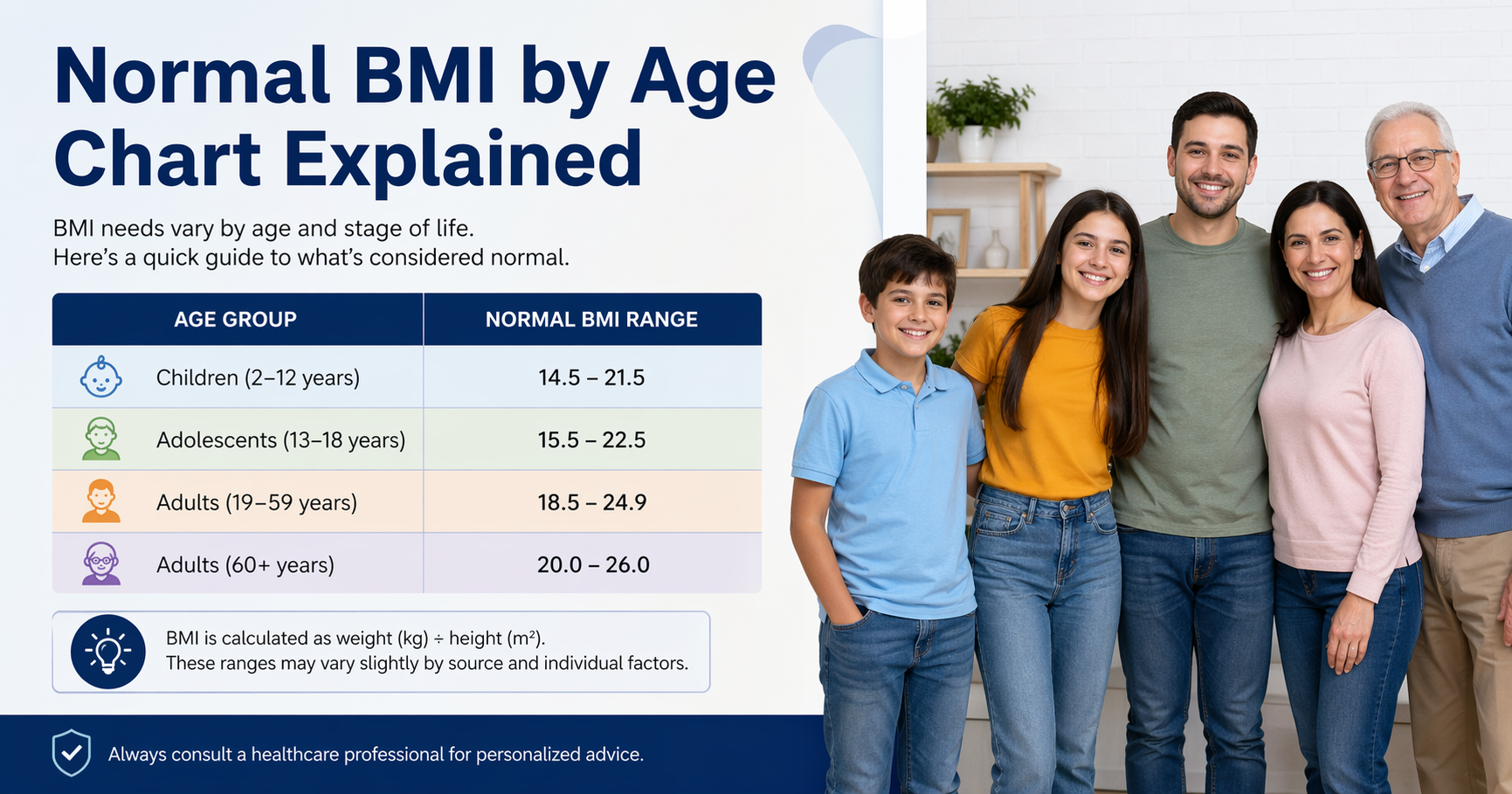
Body Mass Index, or BMI, is a common way to check if a person has a healthy weight for their height. BMI is still an important part of public health, clinical evaluation, and personal wellness tracking, even though it is simple. If you want to quickly calculate your BMI, using an online tool can give you an instant estimate. But one important detail that people often miss is that BMI can mean different things for people of different ages. It’s not always true that a “normal” BMI is the same for everyone, especially when you think about how people grow, get older, and change physically.
This complete guide looks at the idea of normal BMI by age, how to read BMI charts for different stages of life, and why it’s important to know how to read them for each age group in order to get accurate health information.
Understanding BMI and Its Core Concept
A simple math formula divides a person’s weight in kilograms by the square of their height in metres to figure out their BMI. The outcome yields a numerical value that classifies individuals into categories such as underweight, normal weight, overweight, or obese.
BMI is simple to calculate and useful for large-scale health checks, but it doesn’t directly measure body fat, muscle mass, or how fat is spread out. This limitation is particularly significant when analysing BMI across various age groups, as body composition inherently evolves.
Why Age Matters in BMI Interpretation
Age is an important factor to consider when interpreting BMI values. Kids and teens are still growing, so their height, weight, and body composition are always changing. Adults, on the other hand, usually have a stable height but may see changes in their muscle mass and fat distribution over time. As people get older, they often lose muscle mass and bone density, which can change their BMI without necessarily being a sign of real health problems.
Because of these differences, BMI means different things for kids, adults, and older people.
Normal BMI for Children and Adolescents
1. Growth and Development Considerations
For people aged 2 to 19, BMI is not measured by fixed numbers. Instead, percentile charts that show how a child’s BMI compares to other children of the same age and sex are used to figure it out. This method takes into account how growth patterns change naturally.
For kids, a BMI percentile between the 5th and 85th is usually thought to be healthy. Values that are lower than or higher than this range may mean that you are underweight or overweight, respectively.
2. Why Percentiles Are Used
Kids grow quickly, and their height and weight change a lot during these times. A static BMI range would not adequately reflect these dynamic fluctuations. Percentiles give a relative measure, which means that children are evaluated based on where they are in their development.
3. Puberty and BMI Fluctuations
Changes in hormones during puberty can cause body fat or muscle mass to temporarily rise. These changes are normal and shouldn’t be seen as unhealthy right away. This is why it’s more important to keep track of BMI over time than to just take one measurement.
Normal BMI for Adults
1. Standard BMI Categories
For adults between the ages of 20 and 65, BMI is divided into set ranges. Most people think that a BMI between 18.5 and 24.9 is normal. Values lower than this range mean underweight, and values higher than this range mean overweight or obese.
2. Limitations in Adult BMI
BMI is commonly employed; however, it fails to differentiate between muscle and fat in adults. For instance, athletes may have a higher BMI because they have more muscle mass, but they may still be very healthy. People with a normal BMI may still have unhealthy fat distribution, especially around the stomach.
3. Gender Differences
Men and women usually have different amounts of muscle and fat in their bodies. Even with the same BMI, women usually have a higher percentage of body fat than men. But the standard BMI categories don’t take gender into account, which can sometimes lead to confusion.
Normal BMI for Older Adults
1. Changes in Body Composition and Ageing
As people get older, they naturally lose muscle and may gain fat, even if their weight stays the same. Sarcopenia is the name for this process, and it can change BMI readings.
For older adults, a slightly higher BMI may be linked to better health outcomes than for younger adults. A BMI between 23 and 27 is often thought to be okay for older people, but this depends on their overall health.
2. Risks of Low BMI in the Elderly
For older people, being underweight can be more worrisome than being a little overweight. Seniors with a low BMI are more likely to be weak, have a weak immune system, and fall and break bones.
How BMI Changes Across Life Stages
1. Infancy and Early Childhood
Babies gain weight quickly, so their BMI goes up quickly during the first year of life. After that, BMI naturally goes down during early childhood, which is called the adiposity rebound phase.
2. Adolescence
During adolescence, growth spurts and changes in hormones cause BMI to go up again. This phase has a lot of variation, so it is important to use percentiles to measure it.
3. Adulthood
BMI usually stays the same in adults, but things like diet and exercise can cause it to change slowly over time.
4. Older Age
As people get older, their BMI may go down because they lose muscle mass and their metabolism changes. But this doesn’t always mean better health.
Factors That Influence BMI Beyond Age
1. Genetics
Genetic factors significantly influence body composition, fat distribution, and metabolic rate. Some people may naturally have a higher or lower BMI without putting their health at risk.
2. Lifestyle and Physical Activity
A balanced diet and regular exercise can have a big effect on BMI. On the other hand, people who don’t move around much tend to have higher BMI values.
3. Medical Conditions
Some health problems, like thyroid problems or hormonal imbalances, can change your weight and BMI on their own, without any changes to your lifestyle.
Factors that affect society and the environment
Access to healthy food, medical care, and chances to be active can also change BMI trends in different groups of people.
Interpreting BMI in a Practical Context
BMI should be seen as a way to find out if someone has a problem, not as a way to figure out what the problem is. It gives a rough idea of weight status, but it should always be looked at along with other health indicators like waist circumference, blood pressure, and metabolic markers.
Healthcare professionals frequently utilise BMI as an initial metric, subsequently conducting more comprehensive evaluations as required.
What BMI Charts Do
BMI charts show how different heights and weights fit into different weight categories. These charts are different for kids based on their age and sex, but for adults, the ranges are always the same.
To understand these charts correctly, you need to know how to read them. But if you only look at charts and don’t think about other things, you might come to the wrong conclusions.
Common Mistakes People Make About BMI
A common mistake is to think that BMI directly measures body fat. In reality, it is an indirect way to figure out how much you weigh based on your height. Another common misconception is that having a normal BMI means you are healthy, which is not always true.
Some people with a normal BMI may still have high levels of visceral fat, which is linked to higher health risks. On the other hand, people with a higher BMI may be healthy in terms of their metabolism.
How to Use BMI in a Smart Way
Using BMI as part of a bigger health assessment is the best way to use it. Regular monitoring can help you see patterns over time, which is more useful than just one measurement.
When looking at BMI results, it’s also important to think about things like your lifestyle, medical history, and other health indicators.
What Makes Online BMI Tools Useful
It’s easier than ever to figure out your BMI now that digital health tools are more widely available. Online calculators give you answers right away, and many of them also give you extra information based on your age and gender.
These tools are especially useful for people who want to keep an eye on their health without having to do complicated math.
Discover Accurate BMI Tracking with Wideversa
Wideversa.com has the best online BMI Calculator that is completely free to use. If you want a reliable and easy way to figure out your BMI, this is the site for you. The platform is meant to give you correct results and useful advice based on your age and health. Wideversa makes it easy, quick, and available to everyone to keep track of their fitness progress or just find out how much they weigh.
Frequently Asked Questions About BMI
1. What is a normal BMI for grown-ups?
For adults, a normal BMI is usually between 18.5 and 24.9, but other health factors should also be taken into account.
2. Does BMI change as you get older?
Yes, BMI interpretation changes with age because people’s bodies grow, their metabolism changes, and their body composition changes.
3. Is BMI right for kids?
When using age- and sex-specific percentiles instead of fixed ranges, BMI is correct for kids.
4. Is it possible for athletes to have a high BMI?
Yes, athletes often have a higher BMI because they have more muscle mass, which doesn’t always mean they are unhealthy.
5. What is a good BMI for older people?
A BMI between 23 and 27 is often considered healthy for older adults.
6. Does BMI tell you how much fat you have?
No, BMI doesn’t directly measure body fat; it gives an estimate of weight based on height.
7. Why is BMI so important?
BMI helps find possible health risks related to weight and is a way to screen for more tests.
8. Is BMI a bad number?
Yes, BMI can be wrong for people who have a lot of muscle or fat in unusual places.
9. How often should you check your BMI?
You can check your BMI every few months to see how it changes over time.
10. Are BMI calculators on the internet accurate?
Yes, trustworthy online BMI calculators, like the one on Wideversa.com, give you correct and easy-to-understand results.
Summary
BMI is still a useful way to check your weight, but you need to think about your age and other factors when you use it. Kids need to be evaluated based on percentiles because they are still growing, but adults use fixed ranges to classify themselves. When looking at BMI in older adults, be careful because changes in muscle mass and fat distribution can change the numbers.
Knowing how BMI changes with age helps you make better health decisions and get a better picture of your health. Even though BMI isn’t a perfect measure, it’s a good place to start when you look at other health indicators. Using modern tools like online BMI calculators can make the process even easier, which will help people stay informed and take action to improve their health.