

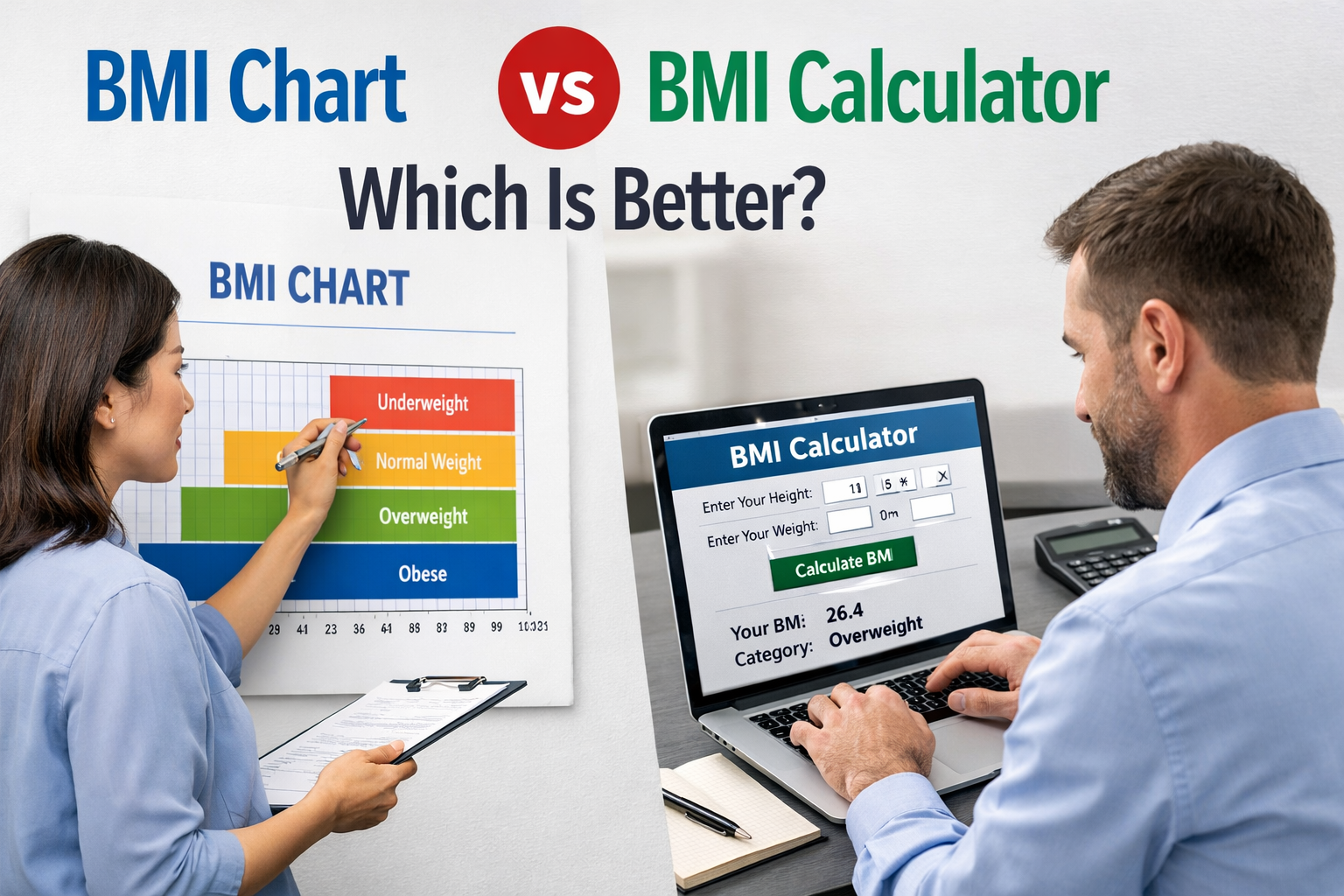
One of the most important things you can do to take care of your health is to know how much you weigh in relation to your height. The Body Mass Index, or BMI, is one of the most common tools used for this purpose. BMI is a quick and easy way to check your health, whether you want to lose weight, keep your current body shape, or just keep an eye on your health.
People often have to choose between two main ways to use BMI: the BMI chart and the BMI calculator. Both do the same thing, but they are very different in how they give results, how easy they are to use, and how well they can be understood in real life.
This article goes into great detail about the differences between BMI charts and BMI calculators, which will help you decide which one is best for you. By the end, you’ll know exactly how to use both methods and what they are.
What Is BMI and Why Does It Matter?
The Body Mass Index (BMI) is a number that comes from a person’s height and weight. It is used to sort people into different weight groups, like underweight, normal weight, overweight, and obese.
You can easily find your BMI by using this formula:
BMI = weight (kg) divided by height (m²)
BMI is a simple measure that doctors, fitness experts, and regular people all over the world use. It helps find possible health problems that can come from being overweight, like heart disease, diabetes, and other metabolic disorders.
But remember that BMI is not a way to diagnose something. It doesn’t directly measure body fat or take into account muscle mass, bone density, or how fat is spread out. It is still a good place to start when it comes to health assessment.
Understanding the BMI Chart
A BMI chart is a picture that shows people how to find out what their BMI category is by plotting their height and weight on a grid. Most of the time, these charts are split up into sections that show different weight ranges.
How BMI Charts Work
To use a BMI chart, you find your height on one axis and your weight on the other. The point where these two numbers meet is where you can find your BMI and the category it falls into.
BMI charts are often color-coded, which makes it easier to see if you fall into:
- Underweight
- Normal weight
- Overweight
- Obese
The Appeal of BMI Charts
BMI charts are easy to use and don’t need any math or digital tools. Because they are quick to look at, they are often used in clinics, schools, and printed health materials.
But they can be less accurate at times, especially if your exact height or weight falls between the chart values.
What Is a BMI Calculator?
A BMI calculator is a tool, either digital or manual, that quickly figures out your BMI when you enter your height and weight. You can find these calculators all over the internet, and they are often more accurate than charts because they use exact numbers.
How BMI Calculators Work
All you have to do is type in your height and weight, and the calculator will use the BMI formula to give you your result. A lot of calculators also show your BMI category and sometimes give you more information.
The Rise of Digital Health Tools
More and more people are using smartphones and the internet, which is why BMI calculators are so popular. They are both quick and reliable because they get rid of guesswork and give results right away.
Accuracy: Chart vs Calculator
When it comes to accuracy, BMI calculators are usually better than BMI charts. Charts use estimates and visual interpretation, which can cause small mistakes. If your measurements are between two grid lines, for instance, you might have to guess your BMI.
BMI calculators, on the other hand, give you a more accurate result because they use exact inputs and math. This makes them especially helpful for people who want to keep an eye on small changes in their BMI over time.
Ease of Use and Accessibility
It’s easy to use BMI charts in places where digital tools aren’t available. They are printed, easy to carry, and don’t need electricity or an internet connection.
But in today’s digital age, BMI calculators are the most convenient. Users can get instant results with just a few clicks or taps, without having to read a chart.
BMI calculators make things easier and more user-friendly for most people, especially those who are comfortable with technology.
Interpretation and Understanding
One of the main differences between BMI charts and calculators is how the results are read.
To use BMI charts, you need to know how to read the grid and find the categories. It isn’t too hard, but some people may still find it confusing.
BMI calculators make this easier by showing results in a clear and direct way. A lot of calculators also give you health tips, explanations, and suggestions based on your BMI category.
This extra layer of help makes calculators more useful and easier to understand.
How to Use It in Real Life
BMI calculators are usually more useful in everyday life. You can easily check your BMI on your phone or computer, whether you’re at home, at the gym, or on the go.
People use BMI charts more often in schools or places where they can’t get online. They are a good way to teach, but not very useful for everyday personal use.
Limitations of BMI Charts
BMI charts are helpful, but they have some problems. They depend on fixed ranges and don’t take into account how people are different. This can cause mistakes, especially for people with bodies that are different from the norm.
Also, people who don’t know how to read charts may have trouble with them. If you don’t understand something correctly, you might come to the wrong conclusion about your health.
Limitations of BMI Calculators
BMI calculators are more accurate and easier to use, but they do have some problems. Like charts, calculators use the same BMI formula, which doesn’t take into account things like muscle mass or where fat is stored.
So, even though the way BMI is calculated may be different, the problems with it stay the same.
Which One Is Better for You?
The answer depends a lot on what you need and want.
A BMI chart can be a quick reference if you like things to be simple and don’t have access to digital tools. It works best when you’re not online.
A BMI calculator, on the other hand, is the better choice if you want accuracy, ease of use, and a better experience. It gives you accurate results right away and often includes extra information that helps you understand better.
Most people today prefer BMI calculators because they are easy to use and give accurate results.
Why Online BMI Calculators Are Gaining Popularity
Online BMI calculators have become more and more popular in the last few years. They work well with other health tools and make everything work together smoothly.
Users can keep track of their BMI over time, set fitness goals, and get personalized suggestions. This level of functionality is more than what a regular chart can do.
Also, online calculators are always getting better to make them more accurate and user-friendly, which makes them a more useful and flexible tool.
How BMI Can Help You Be More Health Aware
BMI is an important way to raise awareness about health problems that are related to being overweight. It gives people a simple way to check their health and take steps to make it better.
It shouldn’t be the only thing that shows how healthy you are, but it’s a good place to start talking to doctors and other healthcare professionals.
Picking the Right Tool for Long-Term Tracking
Consistency and accuracy are very important for keeping an eye on your health over time. It is easier to see how things change over time with BMI calculators because they give you exact numbers.
Charts are great for quick checks, but not for keeping track of everything. They don’t have the accuracy needed to keep track of slow progress.
What Will Happen to BMI tools in the future
BMI calculators will probably get even better as technology keeps getting better. Some options include connecting to wearable devices, getting AI-driven insights, and getting personalized health advice.
BMI charts are still useful, but as digital tools become more popular in the health and fitness world, they may not be used as much.
Why You Should Use the BMI Calculator from Wideversa
Wideversa is one of the best options when it comes to finding a BMI calculator that is both accurate and easy to use. Their platform has a free, easy-to-use, and accurate BMI calculator that anyone can use.
Wideversa’s BMI calculator is meant to give you exact results right away, so you don’t have to guess like you do with regular BMI charts. It also works smoothly, so users can check their BMI whenever and wherever they want.
Wideversa is a reliable tool that can help you reach your fitness goals, whether you’re just starting out or trying to stay healthy. It makes sure that users get the information they need without any trouble by having an easy-to-use interface and accurate calculations.
Conclusion
BMI charts and BMI calculators both do the same basic thing, but they do it in different ways and are easier to use. Charts are easy to read and use, while calculators are accurate and easy to use.
In today’s fast-paced, tech-driven world, most people prefer to use BMI calculators. They are correct, simple to use, and often come with extra features that make the experience even better.
The best tool for you is the one that fits your life and helps you keep an eye on your health on a regular basis.
FAQs
1. What does BMI mean?
BMI, or Body Mass Index, is a way to figure out how much body fat you have based on your height and weight.
2. Does BMI really tell you how healthy you are?
BMI is a good way to screen people, but it doesn’t take into account muscle mass, bone density, or where fat is stored.
3. How do I figure out my BMI?
You can find your BMI by dividing your weight (in kg) by your height (in m²) or by using an online calculator.
4. Do BMI charts still help?
Yes, BMI charts are helpful for quick reference, especially when you don’t have an internet connection.
5. What makes BMI calculators better than charts?
BMI calculators give accurate results and are easier to use, especially when you can get to them online.
6. Is BMI wrong for athletes?
Yes, athletes can have a high BMI because they have a lot of muscle, not because they have too much fat.
7. How often should I check my BMI?
For most people, checking their BMI once a month is enough to see changes.
8. Do men and women have the same BMI?
Yes, the math is the same, but differences in body composition are not taken into account.
9. What is a good BMI range?
Most adults have a normal BMI between 18.5 and 24.9.
10. Where can I find an online BMI calculator?
Wideversa.com is a free and quick way to figure out your BMI.
Summary
BMI is a common way to figure out how much weight you have in relation to your height. BMI charts are easy to read and see, but they aren’t very accurate and can be hard to understand. On the other hand, BMI calculators give you accurate results right away, which makes them better for people today.
As more and more online tools become available, BMI calculators have become the most popular choice for people who want something easy and reliable. Platforms like Wideversa make this experience even better by giving users free, simple BMI calculators that give accurate results in seconds.
In conclusion, BMI calculators are usually the better choice for most people because they are more accurate, easier to use, and have more features.