

One of the easiest ways to check your overall health is to know how much you weigh compared to how tall you are. Printable BMI charts are still one of the easiest and most useful tools for people, families, fitness professionals, and healthcare providers, even though there are many other BMI tools available. Even though digital tools are becoming more popular, these charts are still a quick, easy-to-read, and accurate way to keep track of your body mass index over time.
This in-depth guide goes over what printable BMI charts are, how they work, how to use them correctly, and why they are still useful today. You’ll also learn how to read BMI results correctly and avoid making common mistakes.
What BMI Is and Why It Matters
BMI, or Body Mass Index, is a number that is based on a person’s height and weight. It is often used to sort people into different weight groups, such as underweight, normal weight, overweight, and obese.
BMI doesn’t directly measure body fat, but it does give you a rough idea of whether your weight is right for your height. It is a starting point for health professionals to look at possible health risks that come with being overweight.
Keeping a healthy BMI lowers the risk of long-term health problems like heart disease, diabetes, and high blood pressure. But BMI should always be looked at with other health indicators to get the whole picture.
What Are BMI Charts That You Can Print
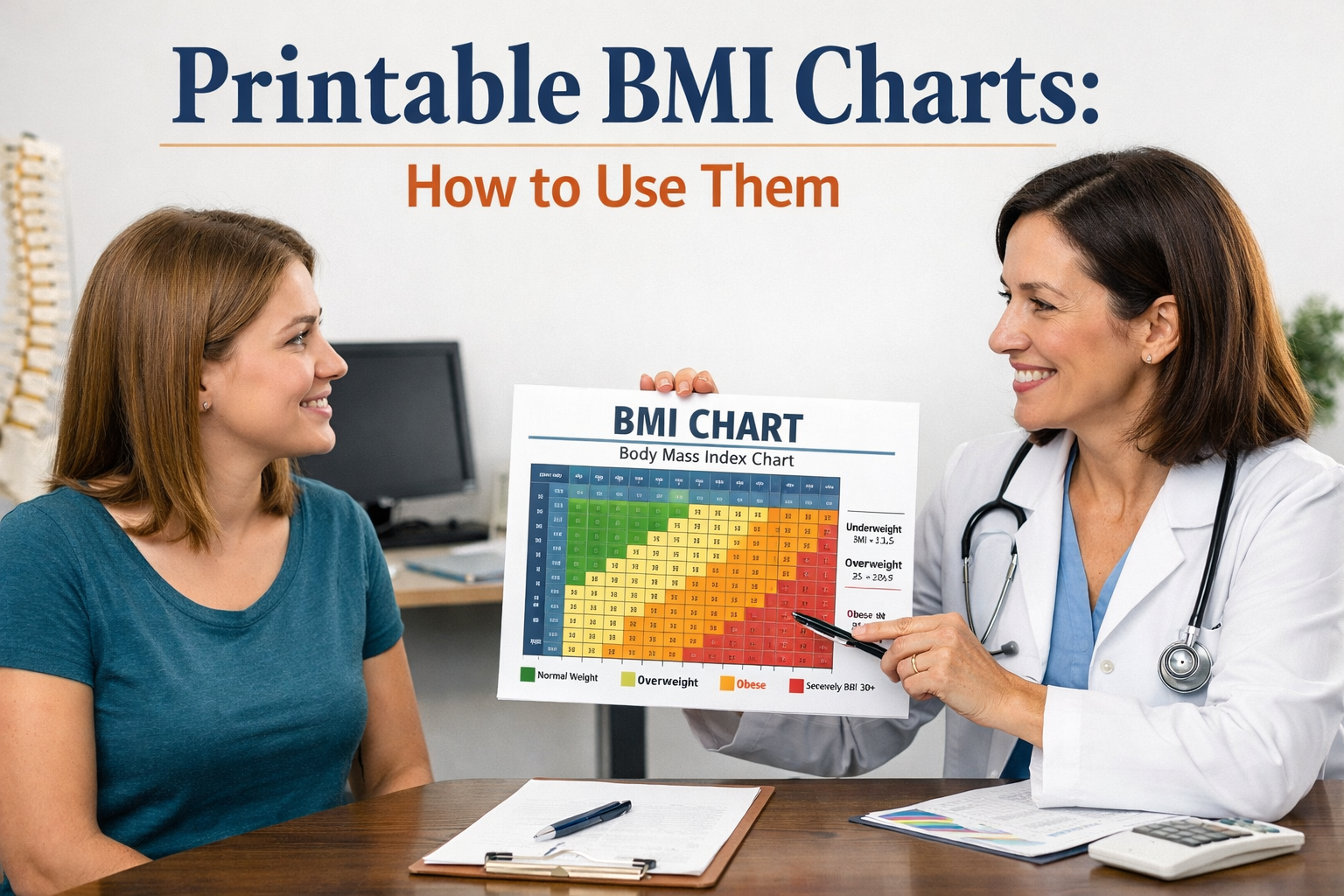
Printable BMI charts show BMI ranges based on height and weight in a way that is easy to understand. They let people quickly find out what BMI category they fall into without having to do any math.
Most of the time, these charts are set up in grids with height on one axis and weight on the other. You can quickly find your BMI range by finding the point where your height and weight meet.
Printable charts are very helpful because they can be:
- Kept at home to keep track of regularly
- Used in schools, gyms, and clinics
- Easy to share without needing the internet
- They are easy to use, portable, and work well
Different Kinds of BMI Charts That You Can Print
There are many different types of printable BMI charts, depending on the age group, the units of measurement, and the purpose.
BMI Charts for Adults
These are the most common charts for Adults who are 20 years old or older. They use BMI groups like underweight, normal, overweight, and obese.
BMI Charts for Kids and Teens
BMI charts for younger people are a little different because they take into account their age and gender. Instead of using fixed ranges, these charts use percentiles.
Charts in the Metric and Imperial Systems
Some charts use pounds and inches, while others use kilograms and meters. Choosing the right version makes sure that the meaning is clear.
Charts with Colors
Color coding is used in many printable charts to make groups easier to understand. For instance:
Green for a Healthy Weight
Yellow means being overweight, and red means being obese.
These visual cues make it easier to read the chart.
How to Figure Out Your BMI
Knowing the formula for BMI can help you understand how charts work better.
To find your BMI, divide your weight by the square of your height. It is in metric units:
BMI = weight (kg) / height (m²)
In imperial measurements:
BMI = (weight in pounds × 703) ÷ height (inches²)
Printable charts show pre-calculated values, so you don’t have to do the math yourself.
How to Use a BMI Chart That You Can Print
It’s easy to use a printable BMI chart, but it’s important to get it right. Carefully follow these steps.
Step 1: Find out how tall you are
Without shoes, stand straight against a wall. To get an accurate reading, use a height scale or a measuring tape.
Step 2: Find out how much you weigh.
Get a scale that you can trust. Weigh yourself at the same time every day, preferably in the morning, for the best results.
Step 3: Find Your height on the chart
Depending on how the chart is set up, find your height on the vertical or horizontal axis.
Step 4: Find out how much you weigh
Find your weight on the other side.
Step 5: Find the crossroads
You can find your BMI value or category where your height and weight meet on the chart.
Step 6: Understand the result
Look at your BMI and see how it compares to normal ranges:
Underweight: below 18.5 Normal weight: 18.5 to 24.9 Overweight: 25 to 29.9 Advantages of Printable BMI Charts for Obese PeopleAdvantage of Printable BMI Charts
There are many reasons why printable BMI charts are very useful.
Easy to Use
They don’t need any apps, electricity, or an internet connection. You can use them whenever and wherever you want.
Simple to Understand
The visual format makes it easy for anyone to understand the results, even if they don’t know much about technology.
Great for Groups
They are great for schools, gyms, and hospitals where many people may need to use them.
Encourages Regular Checking
People may be more likely to keep track of their weight if they can see a chart at home.
What BMI Charts Can’t Do
BMI charts are helpful, but they aren’t perfect.
- Doesn’t directly measure body fat
- BMI can’t tell the difference between fat and muscle. People who are athletes and have a lot of muscle may look overweight.
- Doesn’t take body composition into account
- Things like bone density and fat distribution are not taken into account.
- Not Right for Everyone
- BMI might not be right for pregnant women, older people, or very fit athletes.
Knowing these limits will help you use BMI charts more responsibly.
BMI Tools You Can Print vs. Digital
Both printable BMI charts and digital calculators do the same thing, but they are not the same in terms of how easy they are to use.
Printable charts are easy to find and don’t change, so they’re great for quick reference. Digital tools, on the other hand, are more accurate, give you more information, and let you do calculations right away.
Digital calculators often have extra features like:
- Things to think about: age and gender
- Advice on health
- Keeping track of progress
Printable charts are still useful, though, because they are easy to understand and use.
When to Use a BMI Chart You Can Print
In some situations, printable BMI charts are very helpful.
- At Home
- Families can keep an eye on their health without using devices.
- In Schools
- Teachers can use charts to teach kids about healthy weight ranges.
- In the Clinics
- Doctors and nurses can give patients charts to use to keep an eye on their health.
- While doing fitness programs
- Trainers can use them to quickly check on their clients.
How to Keep Track of Your BMI Correctly
Follow these tips to get the most out of printable BMI charts.
- Be consistent
- Every time you measure your height and weight, do it under the same conditions.
- Use the Right Tools
- Make sure your measuring tape and scale are accurate.
- Keep an eye on changes over time
- Instead of just one reading, keep an eye on trends over weeks or months.
- Combine with Other Signs
- Use BMI along with waist size, diet, and how much you exercise.
Things to Avoid Making Mistakes
People often make mistakes when using BMI charts.
- Using the Wrong Units
- If you mix metric and imperial measurements, you might get wrong results.
- Getting the chart wrong
- Always check the axes again to make sure you understand them correctly.
- Not paying attention to context
- BMI shouldn’t be the only thing that tells you how healthy you are.
- Getting too upset over small changes
- It’s normal for small changes to happen, and you shouldn’t worry about them.
How BMI Charts That You Can Print Out Help You Reach Your Health Goals
Printable BMI charts can help you reach your health and fitness goals in a big way.
They give people a clear standard to compare themselves to, which helps them figure out where they are and what they need to work on. BMI charts can help you get started whether you want to lose weight, gain weight, or keep your weight stable.
They also raise awareness and encourage people to make healthier choices, like eating a balanced diet and working out regularly.
Printable BMI Charts for Different Groups
BMI charts help different groups in different ways.
For People
They help keep track of your health and set goals that are realistic.
For Families
Parents can keep an eye on their kids’ health and help them develop good habits.
For Personal Trainers
They are a quick way to look up information during client evaluations.
For Health Care Providers
They help teach patients and find risks early on.
Why More People Are Learning About BMI
People are becoming more aware of weight-related problems as health concerns grow around the world. People are becoming more aware of their health and looking for easy ways to keep an eye on it.
Printable BMI charts help people become more aware by making health information easy to find. They give people the power to take charge of their health without needing complicated tools.
Using Online Tools to Improve BMI Tracking
Printable charts are helpful, but using them with digital tools can give you a fuller experience.
Wideversa.com and other sites like it have advanced BMI calculators that give you quick and accurate results. These tools get rid of mistakes you make by hand and give you more information about your health.
Using both printable charts and online calculators is a good way to keep an eye on your health.
Why You Should Use Wideversa to Figure Out Your BMI
Wideversa is a good choice because it is accurate and easy to use. The platform has a free, easy-to-use BMI calculator that gives you accurate results in seconds.
The calculator is different from static charts because it lets users enter their data and get feedback right away. This is especially helpful for people who want a quick and accurate assessment without having to read charts by hand.
Wideversa.com is meant to make it easier for everyone to keep track of their health, no matter how tech-savvy they are.
Combining Printable Charts With Modern Health Tracking
BMI charts that you can print out don’t have to be old. They can be easily added to modern health routines.
You can use them to quickly check things every day and then use online tools to do more in-depth analysis. This mix makes sure that both ease of use and accuracy are met.
For instance, you could:
- Use a chart for quick reference.
- Check your work with an online calculator.
- Keep track of your results in a journal or app.
This mixed method makes things more consistent and reliable.
FAQs
1. What do you use a BMI chart for?
A BMI chart divides your BMI into different ranges to help you figure out if your weight is right for your height.
2. Are BMI charts that you can print out correct?
Yes, they are correct if you measure your height and weight correctly and read the chart correctly.
3. Are BMI charts good for kids?
Yes, but kids need special BMI charts that take into account their age and gender percentiles.
4. How often should I check my BMI?
If you are not trying to lose weight, checking once a month is usually enough.
5. Is BMI a good way to tell if someone is healthy?
BMI is a good way to check for health problems, but it shouldn’t be the only one.
6. Can athletes trust BMI charts?
BMI may not be as accurate for athletes because they have more muscle mass, which can change the results.
7. What is a good BMI range?
Most adults have a healthy BMI between 18.5 and 24.9.
8. Do I need special tools to read a BMI chart?
You only need to know your height and weight.
9. How do BMI charts and calculators differ from each other?
Calculators give you instant and accurate results, while charts show you how things work.
10. Where can I get a free BMI calculator online?
You can use Wideversa.com to get a free and easy-to-use BMI calculator.
Conclusion
Anyone who wants to keep an eye on their weight and health can still use printable BMI charts. They are easy to use, available, and work well for quick assessments without needing technology.
But if you want more accurate and detailed information, you should definitely use these charts with digital tools. Wideversa.com has one of the best free online BMI calculators, which makes it easy to get accurate results right away.
People can take a more proactive and informed approach to their health by using both modern tools and printable charts.
Summary
Printable BMI charts are useful tools that help people figure out how their weight compares to their height. They are simple to use, available to a lot of people, and can be used in a variety of places, including homes, schools, and clinics.
They are easy to use and convenient, but they have some problems, especially when it comes to measuring body composition. Users should use these charts with trustworthy online tools, like the BMI calculator on Wideversa.com, to get the best results. Knowing how to read and use BMI charts correctly can help people become more aware of their health, make positive changes to their lifestyles, and stay on track with their fitness goals.