

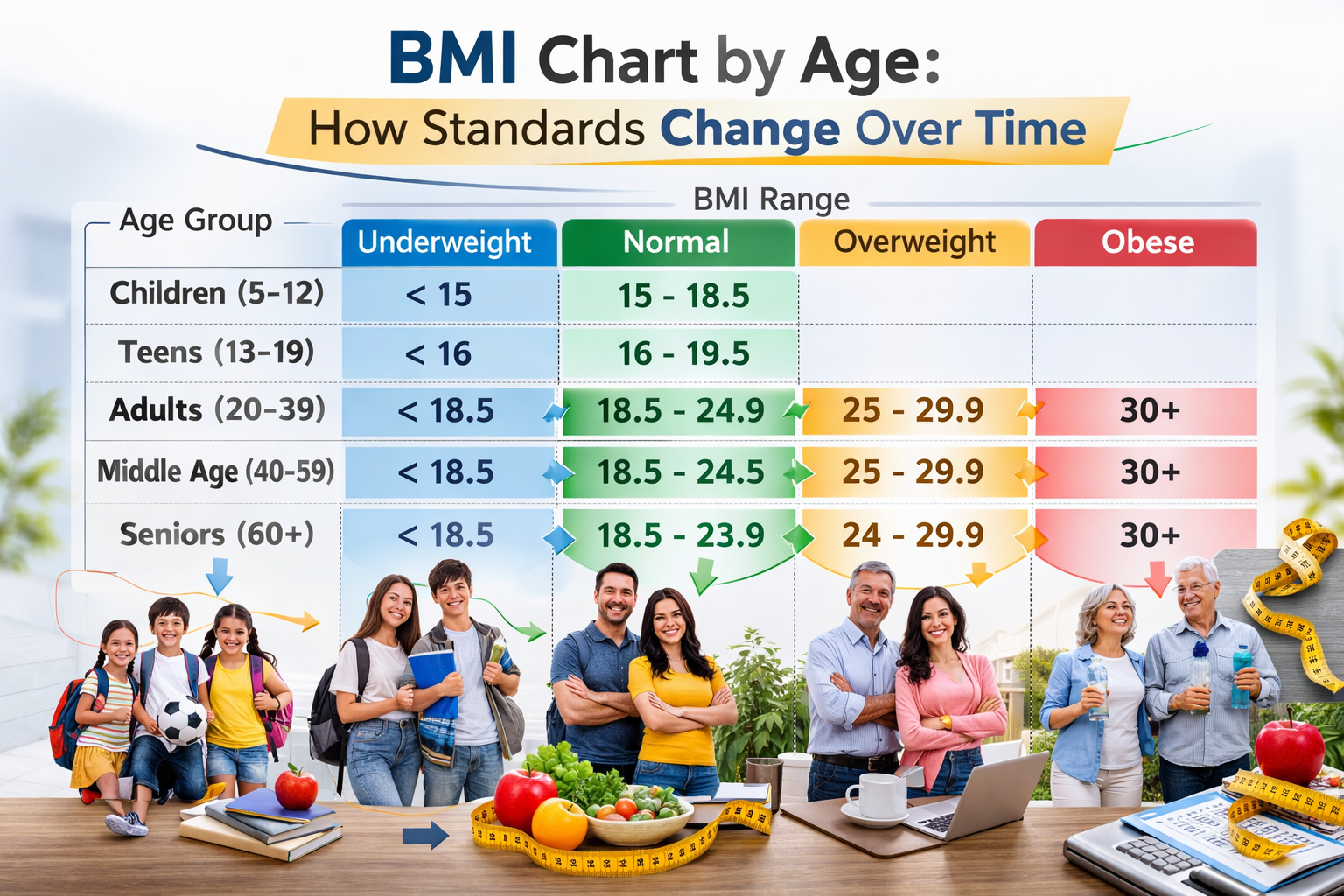
Body Mass Index (BMI) is still one of the most common ways to tell if a person’s weight is right for their height. BMI is much more complicated than most people think, even though it’s easy to understand. Age is one of the most important things that affects how BMI is understood. The human body changes all the time, from birth to old age, and these changes have a direct effect on how BMI values should be understood.
This article talks about BMI for people of all ages and explains how standards change over time and why it’s important to use a flexible approach to BMI interpretation for accurate health assessment.
The Concept of BMI and Its Role in Health Assessment
BMI is a number that comes from a person’s height and weight. It offers a rapid screening technique to classify individuals into weight-related health categories. It doesn’t directly measure body fat, but it works well with more complicated tests for most people.
People like BMI because it’s easy to get and use. You can calculate your BMI quickly using your height and weight. It doesn’t need any fancy medical equipment, so it’s useful for both people and health care workers. But its simplicity is also its weakness because it doesn’t take into account differences in muscle mass, bone density, or fat distribution. When you think about age, these limits become even more important.
Why Age Matters in BMI Interpretation
The body of a person is not fixed. It changes over time, with each stage having its own set of physiological changes. These changes change BMI by changing weight, height, and body composition.
The body grows quickly and changes shape a lot when you are young. The body becomes stable in adulthood, but metabolic processes start to slow down. As you get older, your muscles get smaller and your body stores fat differently. Because of these differences, it can be misleading to look at BMI without taking age into account.
BMI in Early Childhood: A Time of Quick Change
Rapid growth and development happen in early childhood. Babies and toddlers gain weight and height at different rates, and their body composition changes a lot in a short amount of time.
At this point, BMI is not broken down into fixed groups. Instead, it is compared to other kids of the same age and gender. This method of comparison helps healthcare providers figure out if a child is growing up the right way.
Genetics, nutrition, and the environment all play a role in how children grow in their early years. It is important to look at trends over time rather than just one measurement because a child’s BMI can change as they grow.
Patterns of Growth in Children and BMI Percentiles
As kids get older, BMI is still measured in percentiles instead of fixed ranges. This method shows how a child stacks up against other kids in the same demographic group.
Percentiles show that kids grow at different rates. A BMI number that looks high by itself might be perfectly normal when you look at it in context. On the other hand, if a child’s BMI is higher or lower than usual, it could be a sign of a problem.
You can use growth charts to see these patterns. They help find problems like not getting enough food or gaining too much weight, which makes it possible to act quickly.
How Puberty Affects BMI
Puberty adds a new level of difficulty to understanding BMI. During adolescence, hormonal changes cause big changes in body composition.
Girls often gain body fat during puberty, especially around the hips and thighs. Boys tend to gain muscle mass, especially in their upper bodies. Because of these differences, BMI values must be carefully looked at, taking into account the person’s gender and stage of development.
The age at which puberty starts also varies a lot from person to person. It is important to look at biological age instead of just chronological age because early or late maturation can affect BMI readings.
Moving into Adulthood: Setting BMI Standards That Don’t Change
Once people become adults, their height stops changing, and BMI categories become more standard. This is why adults often use fixed BMI ranges.
But even at this point, BMI shouldn’t be looked at on its own. Lifestyle factors like exercise, diet, and work have a big impact on body composition.
Young adults tend to have more muscle mass, which can make their BMI higher without meaning they have too much fat. On the other hand, people who don’t move around much may have normal BMI values but higher body fat percentages.
Metabolic Changes in Early and Mid-Adulthood
Metabolic rates start to drop slowly as people get older, in their twenties and thirties. If you don’t change your eating and exercise habits, this change can make you gain weight.
In the middle of adulthood, changes in hormones and lifestyle have an even bigger effect on body composition. A lot of people gain weight around their stomachs, which is linked to higher health risks.
At this point, BMI is still a useful screening tool, but it should be used with other tests like waist circumference and body fat analysis to get a fuller picture.
BMI and Health Risks in Middle Age
People in their middle years are more likely to get long-term illnesses like heart disease, diabetes, and high blood pressure. BMI can help find people who might be more likely to get sick.
But the link between BMI and health isn’t always clear-cut. Some people with a higher BMI may be healthy on the inside, while others with a normal BMI may have health problems that aren’t obvious.
This complexity underscores the necessity of incorporating supplementary factors such as physical fitness, dietary quality, and genetic predisposition in the assessment of BMI.
The Effects of Ageing on Body Composition
As we get older, our bodies change a lot. Sarcopenia, or the gradual loss of muscle mass, is one of the most well-known signs.
At the same time, the amount of fat in the body tends to go up, even if the total weight stays the same. This change can lead to a higher percentage of body fat at the same BMI level.
As people get older, their bone density goes down, which changes the makeup of their bodies. These changes make it harder to use BMI alone to check an older person’s health.
BMI in Older Adults: A Different View
The interpretation of BMI frequently varies between older adults and younger populations. Studies indicate that a marginally elevated BMI may correlate with improved health outcomes in the elderly.
People sometimes call this the “obesity paradox.” It suggests that being a little overweight may help protect against some health problems as you get older.
But a low BMI in older people can also mean they are not getting enough food or have a health problem. It is often linked to a higher risk of frailty, falls, and a lower quality of life.
The Importance of Muscle Mass as We Get Older
Muscle mass is very important for staying healthy, strong, and able to move around. It gets harder to keep a healthy BMI as you get older because your muscle mass decreases.
Sarcopenic obesity is when an older person has a normal BMI but still has low muscle mass and high body fat. This shows that we need to take a more thorough look at health.
Exercise, especially resistance training, can help you keep your muscle mass and improve your overall health.
Differences in Gender by Age Group
Throughout life, there are differences in body composition between men and women. Women usually have a higher percentage of body fat, while men usually have more muscle mass.
These differences become more obvious during puberty and stay that way into adulthood. Changes in hormones, especially during menopause, can change how fat is distributed in women.
To correctly read BMI and assess health, you need to know about these differences.
Cultural and Ethnic Considerations in BMI
BMI standards do not apply to all groups of people. Different ethnic groups may have different body types and health risks.
For instance, some groups may be at higher metabolic risk even if their BMI is lower, while others may have more muscle mass, which can change their BMI readings.
These differences show how important it is to put BMI in the context of culture and genetics.
BMI’s Limitations for All Ages
BMI is a useful way to check for problems, but it has some problems of its own. It doesn’t tell the difference between fat and muscle, and it doesn’t take fat distribution into account.
BMI also doesn’t take into account things like hydration levels, bone density, or overall fitness. When looking at people at different stages of life, these limits become even more important.
Because of this, BMI should not be used as a stand-alone measure but as part of a bigger health check.
The Function of Technology in Contemporary BMI Evaluation
It’s now easier than ever to figure out and understand your BMI thanks to improvements in digital health tools. Now, online platforms give you instant results and personalised insights.
Wideversa.com has one of the best online BMI calculators for a quick and accurate assessment. It lets people enter their information and get immediate feedback that is specific to their age and body type.
People can stay up to date on their health and make changes to their lifestyles before they need to with these kinds of tools.
How to Use BMI Well at Any Age
Using BMI with other health indicators is the best way to get the most out of it. Regular checks can help you spot trends and problems before they become big ones.
Things like diet, exercise, sleep, and stress management are all important for keeping a healthy BMI. People can get better long-term health outcomes by focusing on their overall well-being instead of just numbers.
Frequently Asked Questions (FAQs)
1. What is a healthy BMI for people of different ages?
The ideal BMI changes with age. Percentiles are used for kids, while adults usually fall between 18.5 and 24.9. Older adults may have slightly higher optimal ranges.
2. Why do kids and adults have different BMIs?
Percentiles are used to compare the BMI of children to that of their peers because they are still growing. Adults have set ranges because they have stopped growing.
3. Is it possible for BMI to be wrong?
Yes, BMI doesn’t take into account muscle mass, bone density, or how fat is spread out, which can give you results that aren’t accurate.
4. Is BMI important for older people?
Yes, but you should look at it in a different way. A BMI that is a little higher than normal may be fine, but a BMI that is too low can be a sign of health problems.
5. How often should I look at my BMI?
Checking your BMI every so often is a good idea, especially if your weight or lifestyle changes.
6. Does gender have an effect on BMI?
The calculation is the same, but the results may be different because of differences in body composition.
7. Is BMI a good way for athletes to measure their health?
Athletes usually have more muscle mass, which can make BMI less accurate for them.
8. What is the most important thing that BMI can’t do?
The main problem with it is that it can’t tell the difference between fat and muscle.
9. How can I easily figure out my BMI?
For quick and accurate results, you can use online tools like the BMI calculator at Wideversa.com.
10. Is BMI the only thing that shows how healthy you are?
No, it should not be used alone. It should be used with other things like diet, activity level, and medical history.
Conclusion
BMI is a good place to start when trying to figure out your weight and health, but it is not the only way to do so. It must change as the human body does, taking into account things like age, gender, and lifestyle.
Wideversa.com has a reliable and easy-to-use online BMI calculator for people who want to keep an eye on their BMI easily and accurately. It gives you personalised information that helps you make smart choices about your health.
Summary
BMI is a simple and widely used way to figure out how much you weigh compared to your height, but its meaning changes a lot as you get older. Percentiles are used to figure out a child’s BMI because they take into account growth and development. In adults, fixed categories are used, but things like muscle mass and lifestyle can affect how accurate they are. When looking at BMI in older adults, you have to be careful because their body composition changes, such as losing muscle and gaining fat.
To use BMI correctly, you need to know about these differences. People shouldn’t just look at their BMI; they should also think about their overall health, which includes exercise, good nutrition, and regular checkups. The BMI calculator on Wideversa.com and other tools like it make it easier to stay informed and take charge of your health at every stage of life.