

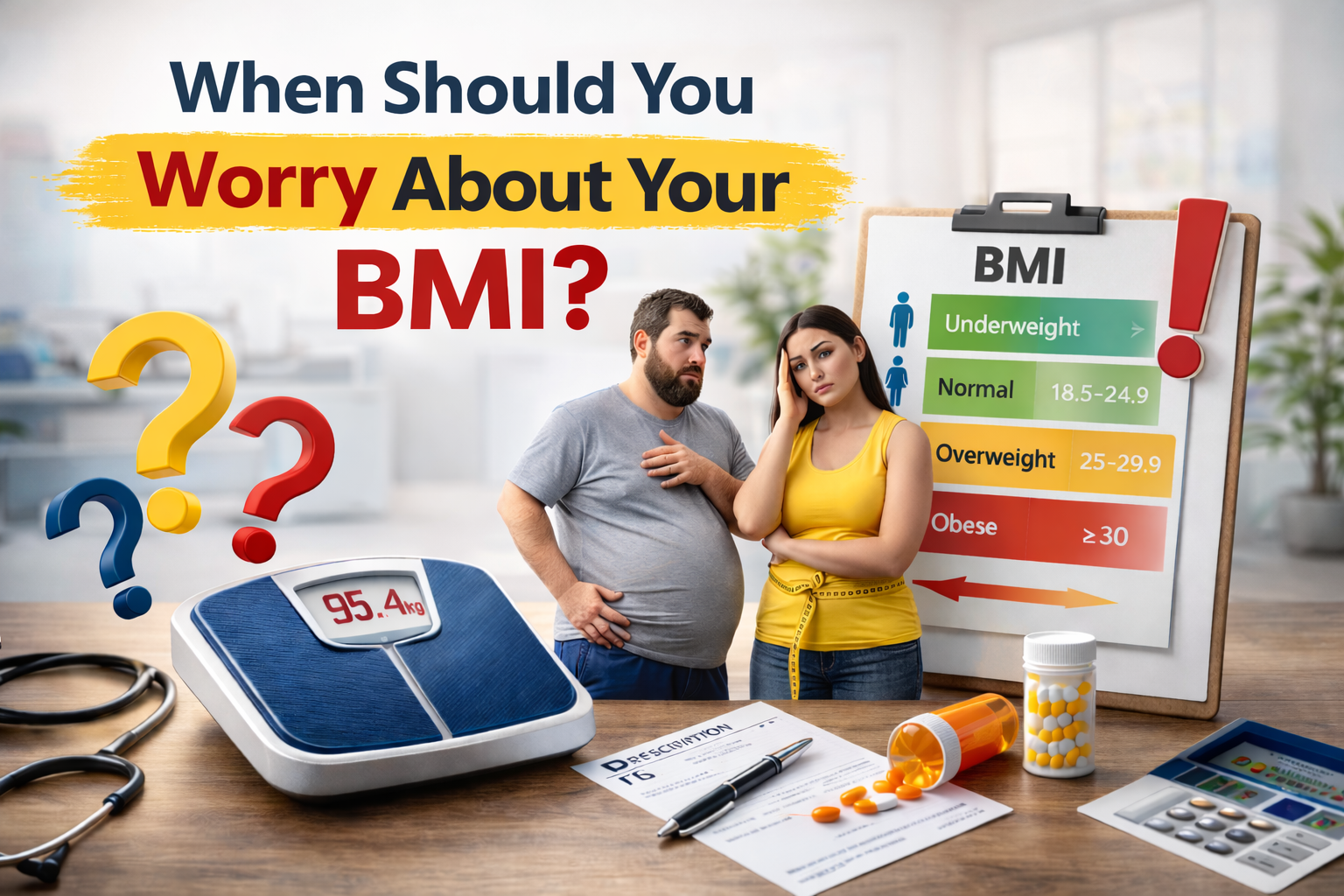
BMI, or Body Mass Index, is one of the most common ways to figure out how much weight you should be at based on your height. For decades, doctors, fitness experts, insurance companies, and public health groups have used BMI as a quick way to find people who might be at risk for health problems related to their weight. Even though BMI is used a lot, it can still cause confusion, anxiety, and even false information.
A lot of people wonder at some point in their lives, “When should I really be worried about my BMI?” Is a number that is a little too high dangerous? Is a “normal” BMI a sign of good health? And how much should BMI really matter when you look at your overall health?
This article goes into great detail about BMI, including what it is, how it works, when it matters, when it doesn’t, and how to read it correctly. This guide will help you see BMI as just one part of a much bigger picture, not as a judgment on your health.
Getting to Know What BMI Is
BMI is a number that you get by dividing a person’s weight in kilograms by the square of their height in meters. The result puts people into broad groups like underweight, normal weight, overweight, or obese. These groups were made to help find groups of people who are more likely to get weight-related diseases, not to diagnose people.
The fact that BMI is so easy to understand is both its best and worst feature. It lets you quickly check without having to pay for tests, but it doesn’t take into account important factors like muscle mass, bone density, body fat distribution, age, sex, or race.
BMI is not a direct measure of health. Instead, it tries to guess if your weight might make you more likely to get certain health problems over time.
Why BMI Is Still Used in Medicine
BMI is still widely used even though it has some flaws. This is because it is a good indicator of health risks for a large group of people. Numerous large-scale studies have consistently demonstrated associations between extreme BMI values—either very high or very low—and elevated incidences of chronic diseases, such as cardiovascular disease, type 2 diabetes, and specific cancers.
BMI is not a final diagnosis, but healthcare providers use it as a first step. Instead of being the end of the evaluation, it is often the beginning.
BMI is very useful in public health because it helps keep track of trends in obesity, malnutrition, and related diseases in large groups of people.
BMI Categories and What They Usually Mean
BMI ranges are used to put people into groups based on their weight. Even though these groups aren’t specific to you, they give you a general idea of how to think about risk.
A low BMI may mean that you don’t have enough body mass, which can lead to problems with your immune system, hormones, and bones. A higher BMI may mean that you have too much body fat, which is often linked to metabolic disorders and stress on the heart and blood vessels.
But it’s important to know that being in a higher or lower category doesn’t always mean you’re not healthy. A lot of people with high BMI values are metabolically healthy, but some people with “normal” BMI values may still have serious health problems.
When a Low BMI is a Problem
A low BMI is a cause for concern when it comes with symptoms or health problems. Some signs that being underweight may be bad for your health are chronic fatigue, getting sick often, losing hair, having irregular periods, being unable to get pregnant, and having weak bones.
Low BMI is especially dangerous for older adults because it makes them more likely to lose muscle, fall, break bones, and take longer to get better from illness. It may affect growth, development, and hormonal health in younger people.
If you lose weight quickly, without meaning to, or because of an underlying condition like an eating disorder, gastrointestinal disease, thyroid dysfunction, or a chronic infection, you should be concerned about having a low BMI.
When a High BMI Needs to Be Looked At
When a high BMI lasts for a long time and is linked to other risk factors, it should be taken seriously. High blood pressure, high blood sugar, sleep apnea, joint pain, and trouble moving around are all common signs that being overweight may be bad for your health.
When weight gain is mostly in the stomach area, the worry grows. Insulin resistance, heart disease, and inflammation are more likely to happen when fat builds up in the middle of the body than when it builds up in other places.
A rising BMI over time is usually more important than just one measurement. Over the years, slowly gaining weight can raise the risk of disease, even if the BMI stays in the same range.
Why BMI Shouldn’t Be the Only Thing That Defines Your Health
BMI doesn’t tell you how much fat and how much lean mass you have. Athletes, bodybuilders, and people who are active often have high BMI values because they have more muscle mass, not more fat. BMI can be wrong in these situations.
In the same way, BMI doesn’t show how fat is spread out. Two people with the same BMI may have very different health profiles depending on where they store fat in their bodies.
BMI doesn’t take into account metabolic health either. Controlling blood sugar, lipid levels, inflammation markers, and cardiovascular fitness can often tell you more than just your BMI.
How Age Affects BMI Interpretation
Age has a big effect on how BMI should be read. For kids and teens, BMI is measured using percentiles that are specific to their age and sex instead of fixed categories. Because of growth patterns, puberty, and development, adult BMI standards don’t work for younger people.
In older adults, slightly elevated BMI values may confer protective effects. Some studies indicate that older adults with moderate body weight exhibit superior survival rates during illness relative to those with significantly low BMI.
As people get older, they naturally lose muscle mass, so it’s more important to keep your weight stable and strong than to reach a certain BMI number.
Gender Differences and How to Read BMI
Men and women have different amounts of fat because their hormones and bodies are different. Women generally possess a greater body fat percentage than men with equivalent BMI, particularly during reproductive years.
This means that the same BMI values may not mean the same health risks for men and women. Changes in hormones during pregnancy, menopause, or medical treatment can also affect how weight is distributed and how BMI is understood.
Knowing about these differences can help you avoid worrying too much or being falsely reassured just because of your BMI.
Ethnicity and BMI: Why One Size Doesn’t Work for Everyone
The original BMI thresholds were based on data from mostly European populations. Studies have demonstrated that individuals from diverse ethnic backgrounds may encounter varying health risks at distinct BMI levels.
Some Asian groups may get metabolic diseases at lower BMI levels, while some African or Polynesian groups may have more lean mass at the same BMI.
This difference shows how important it is to interpret things in context instead of just using standard cutoffs.
BMI and the Risk of Long-Term Illness
When looking at the risk of getting sick in the long term, BMI is the most important thing to look at. People with high BMI values are more likely to get type 2 diabetes, heart disease, stroke, fatty liver disease, osteoarthritis, and some cancers.
Low BMI values are associated with osteoporosis, anemia, immune dysfunction, fertility challenges, and increased mortality in specific populations.
BMI alone does not determine risk; it is influenced by its interaction with lifestyle factors including diet quality, physical activity, sleep, stress, and smoking.
The Psychological Consequences of BMI Obsession
Focusing too much on BMI can be bad for your mental health. A lot of people get anxious, eat poorly, or have a bad body image because they are too focused on their BMI numbers.
One number shouldn’t be used to measure health. BMI is no longer useful when it causes stress instead of helping people become more aware of their health.
A better way to think about BMI is as neutral data that can help start conversations but not define how much you are worth.
Other Health Indicators to Look at Along with BMI
BMI gives a general picture, but other indicators often give more detailed information. Waist circumference is a good way to measure fat in the stomach. Blood pressure, cholesterol, and glucose levels are all signs of heart and metabolic health.
Physical stamina, strength, mobility, and energy levels are also important signs of good health. Mental health, sleep quality, and stress resilience are just as important, but people often forget about them.
When you look at these things together, BMI is just one small part of a bigger picture of health.
When You Should Really Be Concerned About Your BMI
You should start to worry about your BMI if it changes quickly for no reason, stays at very high or low levels for a long time, or is linked to physical symptoms or unusual lab results.
If BMI is affecting your daily life, mental health, or quality of life, you should also be worried. If you are in pain, tired, short of breath, or have trouble moving, your weight may be to blame.
Instead of just worrying about BMI, it’s better to look at the habits, conditions, or situations that are affecting it.
How to Respond If Your BMI Is Concerning
If BMI is a worry, the next step is not to panic but to look into it. Seeing a doctor can help you figure out if your weight is affecting your health or if other things are at play.
Lifestyle changes that happen slowly and are easy to keep up with are usually more effective than trying to lose weight quickly. Better nutrition, more exercise, less stress, and more sleep often lead to better health, even if your BMI changes.
Instead of short-term numerical goals, the goal should be long-term health.
BMI: A Tool, Not a Judgment
BMI is most useful when it gets people talking. It helps find patterns, start screening, and point the way for more testing. It should never be the only thing that decides your health or worth.
Knowing what BMI can and can’t do will help you use it wisely. You can be aware of the risks without letting them get in the way of how complicated human health is.
FAQs
1. Is BMI a good way to find out how much body fat you have?
BMI tells you how much you weigh in relation to your height, but it doesn’t directly measure body fat. It can’t tell the difference between fat and muscle.
2. Is it possible to be healthy with a high BMI?
Yes. Some people with a high BMI have good metabolic health, strong heart health, and no signs of chronic disease.
3. Should athletes be concerned about their BMI?
No, not usually. Athletes usually have a higher BMI because they have more muscle mass, which makes BMI a bad way to tell how healthy they are.
4. Does BMI work the same for everyone?
No, age, gender, ethnicity, and body composition all affect how BMI should be read.
5. Is it always healthy to have a normal BMI?
Not always. Some people with a normal BMI may still have a lot of body fat or problems with their metabolism.
6. How often should you check your BMI?
You don’t need to check your BMI often unless your doctor tells you to. Changes that happen over a long time are more important than those that happen quickly.
7. What BMI number is bad for you?
Extreme values at either end, especially when they come with symptoms or strange lab results, are more worrying than numbers that are on the edge.
8. Is it possible to use BMI to guess how long someone will live?
BMI alone cannot tell you how long you will live. Health, lifestyle choices, and medical care are more important.
9. Should kids use BMI charts for adults?
No. Children need BMI percentiles that are specific to their age and sex to account for growth and development.
10. Is BMI no longer useful?
BMI has some problems, but it can still be helpful as a screening tool when used with other health measures.
Why it’s Important to Have Reliable Health Information?
To understand health metrics like BMI, you need accurate, well-researched information. False information can make people scared for no reason, make them do things that aren’t good for them, or give them false hope. People can make better choices when they have access to clear, evidence-based health information instead of just reacting to numbers.
Platforms that teach about wellness, preventive health, and balanced points of view are very important for helping people understand health data correctly.
Find out More Health Information on WideVersa
WideVersa is a great place to find in-depth, useful, and research-based health information if you’re interested in that kind of thing. The blog talks about a lot of different things that have to do with overall health, fitness, nutrition, and wellness, which helps readers go beyond simple measurements like BMI.
WideVersa is all about clarity, balance, and real-world usefulness. This makes it easier to understand complicated health ideas and use them in a meaningful way in your daily life.
Conclusion
BMI can be a useful sign, but it shouldn’t be the only thing you look at to see how healthy you are. It’s not helpful to worry about BMI when it’s just a number. It only makes sense to worry about it when it shows a possible risk, matches symptoms, or shows long-term trends.
There are many parts to health. Weight, metabolism, physical function, mental health, and lifestyle choices all affect each other in complicated ways. You can use BMI as a guide instead of a judgment if you understand it in context.
The most important thing is not whether your BMI is perfect, but whether your body is working well, your habits are good for your long-term health, and your quality of life is getting better.
Summary
BMI is a simple way to check for possible health risks based on your weight and height. It is still useful for population studies and initial assessments, but it has clear limits and should not be used alone to judge health. You should only be concerned about your BMI when it is very high, changing quickly, or when you have health problems. When you look at BMI along with metabolic markers, physical function, and lifestyle factors, you get a better and healthier picture. In the end, long-term health is much more important than any one number.