

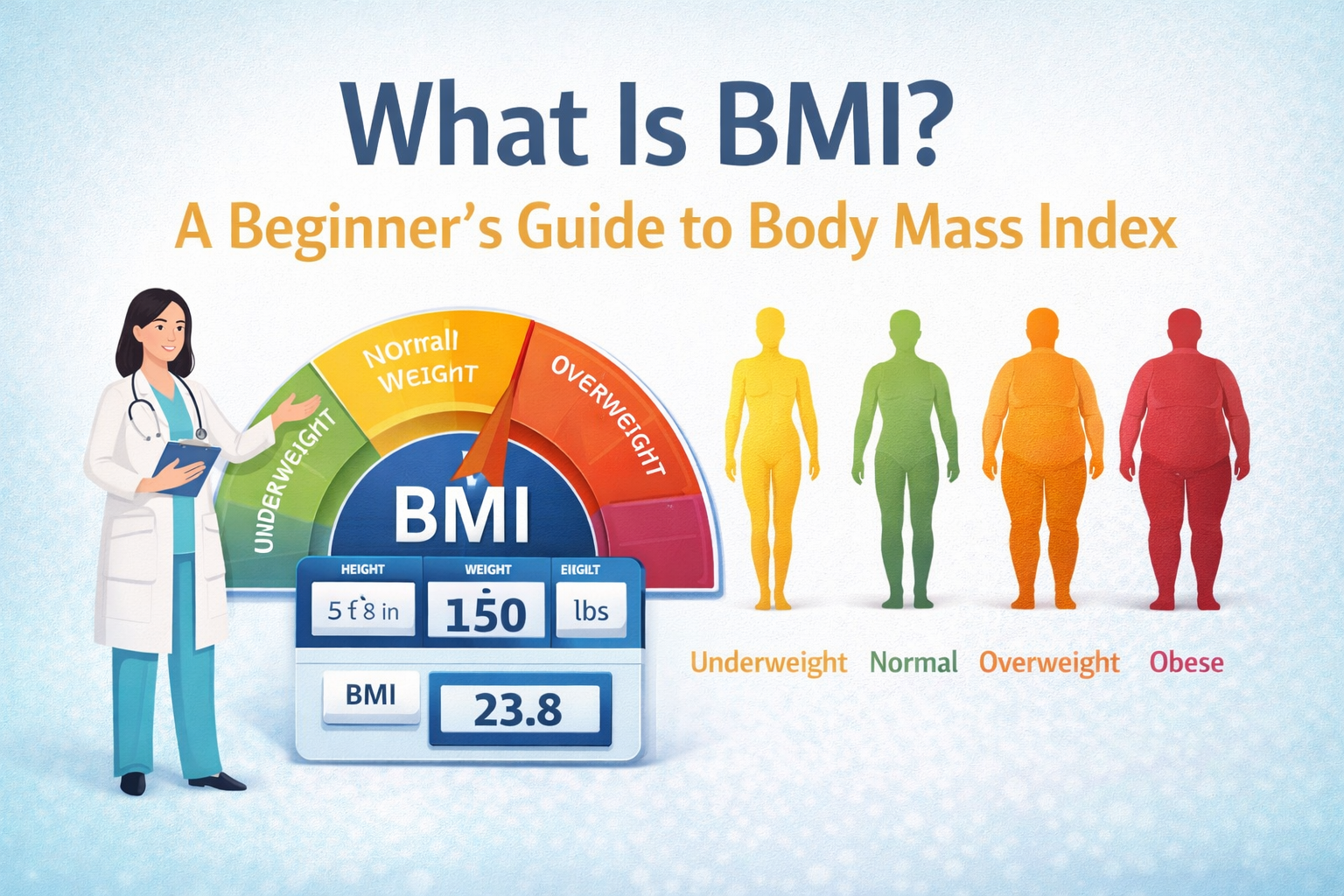
The Body Mass Index (BMI) is one of the most frequent ways to find out whether a person’s weight is appropriate for their height. BMI is often used by doctors, nutritionists, fitness experts, insurance companies, and public health groups to quickly sort people into weight-related health categories. BMI might be hard to understand or too simple for novices, particularly when it is spoken about with complicated themes like obesity, metabolism, and the risk of chronic illness.
This in-depth tutorial will help you comprehend BMI in a clear, useful, and easy-to-understand way. You will discover what BMI is, how to figure it out, why it is used, what the various BMI categories signify, and what its limits are. We will also talk about how BMI affects health in general, who should and shouldn’t use it, and how contemporary techniques have made it easier and more accurate to figure out BMI. You will be able to reliably read your BMI and see how it fits into a bigger picture of health by the conclusion of this essay.
What Is BMI?
The Body Mass Index (BMI) is a number that comes from a person’s height and weight. Most individuals should be able to use it to get a rough idea of how much body fat they have. The idea behind BMI is simple: when body weight goes up compared to height, the risk of several health problems also goes up.
BMI does not directly measure body fat. Instead, it utilizes height and weight as indirect signs. Even though this is a problem, BMI has been helpful on a population level because it lets academics and healthcare practitioners keep track of changes in obesity, overweight, and underweight among large groups of individuals.
The World Health Organization (WHO) and many national health authorities agree that BMI is a good way to screen people. One of the most extensively used health measurements in the world, it is simple, cheap, and easy to use.
The History and Origin of BMI
Adolphe Quetelet, a Belgian mathematician and statistician, came up with BMI in the early 1800s. Originally termed the “Quetelet Index,” it was not meant to be used as a medical diagnosis tool but rather as a technique to characterize the typical body shape of groups of people.
BMI didn’t become prominent in medicine and public health until the middle of the 20th century. Researchers found that BMI was a good way to measure body fat and illness risk in large groups of people. It became a conventional way to figure out an adult’s weight throughout time.
Even though there are still arguments regarding its limits and best uses, BMI is now an important part of healthcare systems, research projects, and health recommendations all across the globe.
How Is BMI Calculated?
A basic arithmetic formula that relates weight to height is used to figure the BMI.
The BMI Formula
Metric system: BMI = weight (kg) ÷ height² (m²)
Imperial system: BMI = (weight (lb) ÷ height² (in²)) × 703
For example, if a person weighs 70 kilograms and is 1.75 meters tall, their BMI would be calculated as follows:
70 ÷ (1.75 × 1.75) = 22.86
This BMI number would indicate that the individual is at a healthy weight.
Even if the formula is easy, doing the math by hand might take a long time and be wrong. That’s why digital health tools and internet calculators are now the best way to get an accurate BMI.
BMI Categories and What They Mean
After calculating BMI, it is compared to standard categories set by the World Health Organization.
Standard BMI Categories for Adults
- BMI less than 18.5 means you are underweight.
- BMI between 18.5 and 24.9 is normal weight.
- BMI 25.0–29.9 means you are overweight.
- Obesity (Class I): BMI between 30.0 and 34.9
- Obesity (Class II): BMI 35.0–39.9
- Obesity (Class III): BMI 40.0 and above
These groups assist doctors and nurses find people who may be more likely to have health issues because of their weight. It’s crucial to note that BMI categories are not final diagnoses; they are only ways to examine people.
Why Is BMI Important?
BMI is significant since it gives a fast look at the health hazards that come with being overweight. Many studies have indicated that having a very low or very high BMI increases the risk of a number of health problems.
A high BMI is typically connected to difficulties with the heart, type 2 diabetes, high blood pressure, stroke, certain malignancies, and joint pain. A very low BMI, on the other hand, may mean that you are not getting enough nutrients, your immune system is not working as well, you have osteoporosis, or you are having trouble becoming pregnant.
From a public health point of view, BMI helps governments and health groups keep track on obesity trends, come up with ways to stop it, and use healthcare resources more efficiently.
BMI and Overall Health Risk
BMI alone can’t tell you how healthy you are, but it does show a link between health risk and population level. The risk of getting chronic illnesses is up when BMI goes up beyond a certain point.
But danger is not spread out equally. Two people with the same BMI may have quite different health profiles based on things like how their fat is distributed, how much muscle they have, their genetics, their lifestyle, and their metabolic health. Because of this, BMI should always be looked at along other health markers.
Limitations of BMI
BMI is widely used, however it has certain major flaws that novices should be aware of.
First, BMI doesn’t tell the difference between fat and muscle. People who are athletes or have a lot of muscle mass may have a high BMI even if they don’t have a lot of body fat. On the other hand, a person with a normal BMI might yet have a lot of body fat.
Second, BMI doesn’t take into consideration where the fat is on the body. BMI can’t show the difference between fat in the stomach and fat in other parts of the body, even though belly fat is more dangerous to health.
Third, BMI doesn’t take into account things like age, sex, or race. Body composition and illness risk may change markedly across various groups.
Because of these problems, BMI should be seen as a starting point, not a final assessment of health.
BMI for Different Groups
1. BMI in Adults
BMI classifications are most accurate for those between the ages of 18 and 65. When used with other tests, BMI gives a really good idea of health risks connected to weight in this population.
2. BMI in Children and Teenagers
People look at BMI in various ways for kids and teens. BMI-for-age percentiles are used to take growth and development into consideration instead of predefined categories. This makes sure that weight is compared to that of other people of the same age and sex.
3. BMI in Older Adults
A little higher BMI in elderly persons may not be detrimental and may sometimes provide protection. Changes in bone density and muscle atrophy make it harder to understand BMI in this age range.
4. BMI in Athletes
Because they have more muscular mass, athletes frequently have higher BMI levels. In certain situations, BMI could wrongly label individuals as overweight or obese, which shows that further tests are needed.
Alternatives and Complements to BMI
Healthcare practitioners commonly employ BMI with other metrics since it has certain flaws. These might include things like waist circumference, waist-to-hip ratio, body fat percentage, and metabolic indicators like blood sugar and cholesterol levels.
When used together, these tools provide a better picture of a person’s health than BMI alone.
How to Check Your BMI Accurately Online
It’s now easier, quicker, and more precise to figure out your BMI using digital tools than it was with traditional approaches. Advanced BMI calculators not only tell you your BMI, but they also explain what it means for your health and often provide you specific advice.
Using a trustworthy online BMI calculator cuts down on mistakes in calculations and helps people comprehend what their BMI implies in real life.
Using Wideversa’s Advanced BMI Tool
Before making any decisions regarding your health or weight, you need to know how to accurately calculate and understand your BMI. Wideversa has a high-tech BMI instrument that is easy to use and accurate. The program lets users enter their height and weight, quickly calculates their BMI, and then simply explains what the result means in terms of typical health categories.
Wideversa’s BMI tool is very helpful since it is easy to use for beginners and gives a lot of information. It doesn’t only display a number; it also helps people comprehend what that number means and how it could connect to their health objectives. Wideversa is a great place for anybody who wants to check their BMI and make smart choices about their health to start.
Conclusion
Body Mass Index is still one of the most used ways to figure out how much weight is bad for your health. It is not a perfect metric, but it is a good place to start when trying to understand how body weight affects health. Beginners may use BMI more wisely and responsibly if they grasp how it is calculated, what the different categories signify, and what its limits are.
When used with other health metrics and expert advice, BMI may help people make smart choices about their diet, exercise, and long-term health.
10 Frequently Asked Questions (FAQs) About BMI
1. What does BMI stand for?
Body Mass Index is what BMI stands for. To figure out how much body fat a person has, you take their height and weight and turn them into a number.
2. Is BMI an accurate measure of body fat?
BMI is a roundabout way of measuring body fat. It gives a rough idea and works best when used with other health signs.
3. What is a healthy BMI range?
A BMI between 18.5 and 24.9 is healthy for most individuals.
4. Can athletes have a high BMI and still be healthy?
Yes. Athletes frequently have more muscle mass, which might raise their BMI without showing that they have too much body fat.
5. Does BMI apply to children?
BMI is utilized for kids, however instead of utilizing adult categories, it uses percentiles based on age and sex.
6. Why do doctors still use BMI despite its flaws?
BMI is a straightforward, cheap, and helpful way to find possible health hazards in a group of people.
7. Can BMI predict disease?
BMI alone doesn’t tell you whether you have an illness, but having a higher or lower BMI might mean you’re more likely to have certain health problems.
8. How often should I check my BMI?
If you aren’t making big changes to your weight or lifestyle, checking your BMI every few months is generally enough.
9. Is BMI the same for men and women?
The computation is the same, but BMI may have distinct effects on men and women since their bodies are made up differently.
10. What is the best way to calculate BMI?
The best way to get accurate results is to utilize a dependable internet calculator, like the sophisticated BMI tool on Wideversa.
Summary
BMI, which stands for Body Mass Index, is a simple way to figure out how much weight you should be in depending on your height and weight. A lot of people use it as a screening tool, although it doesn’t directly evaluate body fat or health in general. Beginners may appropriately understand their findings if they know what BMI is for, what its categories are, and what its limits are. As part of a larger health review, using precise tools like Wideversa’s sophisticated BMI calculator may make BMI testing simpler, clearer, and more useful. Keep following Wideversa.com for more health oriented topics.