

One of the most essential things you can do for your long-term health is to keep your body weight in check. Body Mass Index (BMI) is still one of the most well-known and extensively used ways to quantify body weight and health risk . BMI is often used by doctors, nutritionists, fitness experts, and public health groups to see whether an adult’s weight is in a healthy range.
But people commonly get BMI wrong. A lot of individuals know their BMI number but don’t know what it really means, whether it really indicates health, or how to use it with other health indicators. This article goes into great detail on what a healthy BMI range for adults is, how BMI is calculated, why it matters, its limits, and how people may utilize it wisely to help them stay healthy.
Understanding BMI: What Does It Mean?
The Body Mass Index is a number that comes from a person’s height and weight. It gives a typical approach to guess whether an adult’s weight is healthy for their height. BMI doesn’t directly measure body fat, but for most individuals, it is a good indicator of body fat when compared to other metrics.
In the 1800s, the idea of BMI came around. Later, global health organizations used it as a way to assess people. The World Health Organization (WHO) and the Centers for Disease Control and Prevention (CDC) utilize BMI to sort people into weight groups and find any health problems that come with being too thin or too heavy.
How BMI Is Calculated for Adults
You may easily figure out your BMI by following this formula:
BMI = weight (kg) ÷ height² (m²)
The formula is changed for those who use pounds and inches. The computation is easy, but the real importance is in how you interpret the number.
BMI is only for those who are 18 years old or older. Kids and teens need distinct BMI-for-age percentiles since their bodies are still growing.
What Is Considered a Healthy BMI Range for Adults?
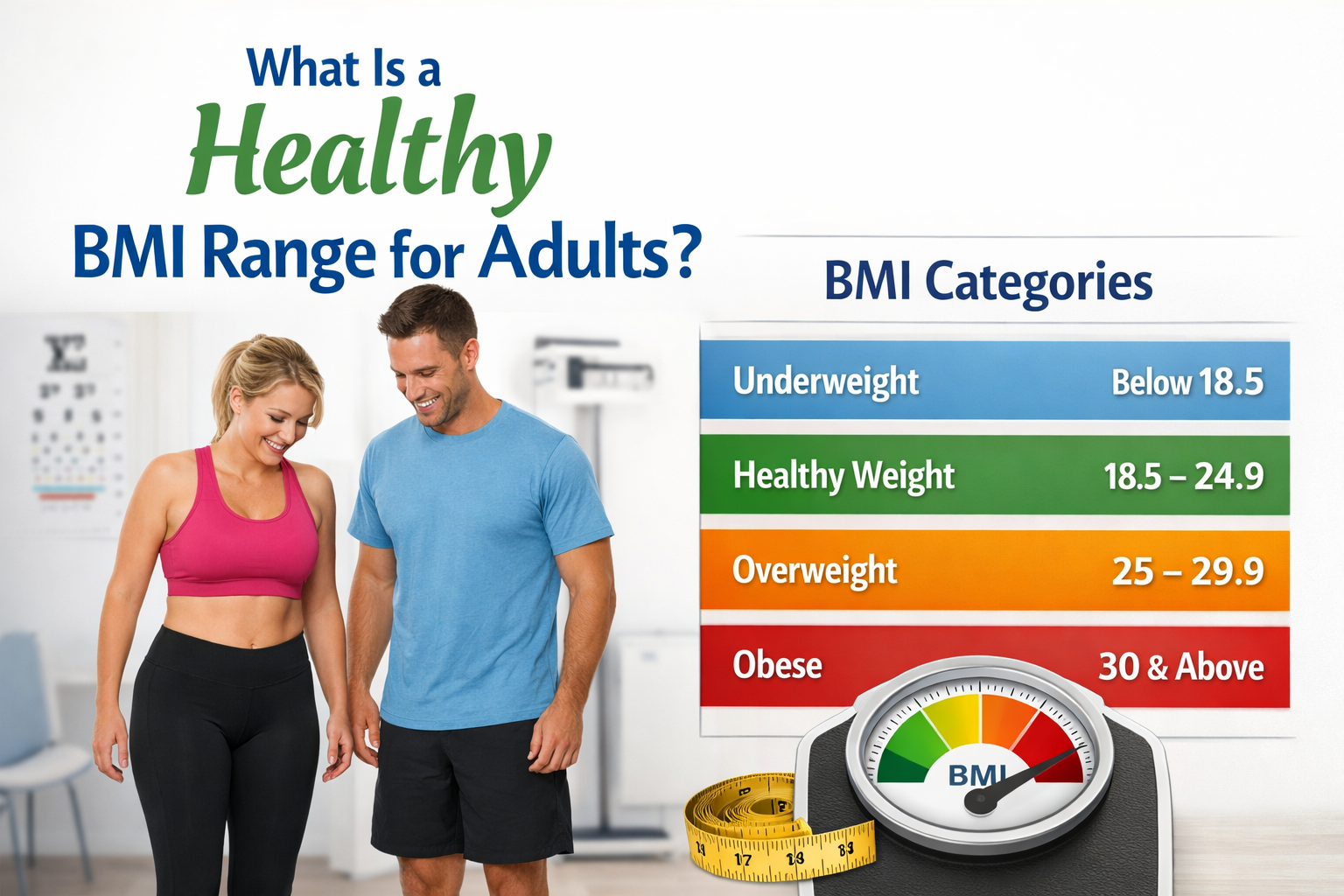
Most persons have a healthy BMI between 18.5 and 24.9. Most persons in this range have the lowest risk of chronic illnesses and death in general.
People with a BMI in this range are usually seen to have a healthy weight for their height. Studies consistently indicate that persons within this BMI range exhibit reduced risks of cardiovascular illness, type 2 diabetes, musculoskeletal diseases, and certain malignancies in comparison to those outside this range.
It’s crucial to remember that BMI is not a test that can tell you whether you have a disease. A healthy BMI does not inherently suggest that a person is in perfect health, and a BMI outside of the normal range does not always mean that a person is not healthy. Instead, BMI should be seen as a starting point for a more complete health evaluation.
Why the Healthy BMI Range Matters
There is a reason behind the healthy BMI range. It is based on years of epidemiological research that has shown a relationship between body weight and health consequences. Adults who keep their BMI in the appropriate range usually have better metabolic health, more mobility, and less stress on their essential organs.
Extra weight puts more stress on the heart, lungs, joints, and endocrine system. Over time, this may make it more likely that you will have high blood pressure, insulin resistance, fatty liver disease, and issues with your muscles and bones. Being underweight, on the other hand, may make the immune system weaker, lower bone density, and throw off hormone balance.
Keeping a healthy BMI is consequently directly linked to living longer, having a better quality of life, and avoiding illness.
BMI Categories Explained in Detail
BMI readings are put into standard groups to make it easier to find any health hazards. The healthy range is in the center, but knowing all the categories gives you useful information.
If your BMI is less than 18.5, you are considered underweight. This might mean that you aren’t getting enough nutrients, that you have a medical issue, or that you’re putting too much stress on your body. Being underweight for a long time might make you more likely to have osteoporosis, anemia, problems with fertility, and a weakened immune system.
A healthy BMI is between 18.5 and 24.9. People in this range usually have a healthy amount of body mass for their height, which helps their bodies work well.
If your BMI is between 25 and 29.9, you are overweight. This range doesn’t necessarily mean you have health issues right now, but it does mean you’re more likely to develop metabolic abnormalities over time.
If your BMI is 30 or greater, you are considered obese. Obesity is classified into many categories and is linked to markedly elevated risks of cardiovascular disease, diabetes, sleep apnea, and reduced life expectancy.
Does BMI Accurately Measure Health?
BMI is a helpful tool for looking at groups of people, but it doesn’t work as well for individuals. One of the most prevalent complaints with BMI is that it doesn’t tell the difference between muscle mass and fat mass. Because of this, athletes or people with a lot of muscle may have a high BMI even when they don’t have a lot of body fat.
In the same way, BMI doesn’t take into consideration how fat is spread around. For instance, fat in the stomach is more dangerous for your health than fat in other places, yet BMI regards all weight the same. Age, sex, and ethnicity may also affect how body fat is spread out and how health hazards show up at different BMI levels.
Because of these limits, BMI shouldn’t be used on its own; it should be used with other health indicators.
BMI and Age: Does the Healthy Range Change?
The healthy BMI range for people stays the same no matter how old they are. But as individuals become older, the way they understand BMI may vary a little. As people become older, their muscle mass, bone density, and fat distribution inevitably alter.
A higher BMI in elderly folks may not provide the same danger as it does in younger individuals. On the other hand, having a BMI on the lower end of the healthy range may make older adults more likely to become feeble. This shows how important it is to have personalized health checks instead than just relying on BMI figures.
BMI Differences Between Men and Women
Men and women have the same BMI categories, but since their bodies are different, they may have distinct health risks with the same BMI. Women usually have more body fat than males, whereas men usually have greater lean muscle mass.
Even though these disparities exist, BMI is still a good way to test for both men and women. When looking at BMI statistics for men and women, healthcare experts typically take into account other things including waist size, body fat percentage, and hormonal health.
The Role of Waist Circumference Alongside BMI
People typically utilize waist circumference together with BMI to get a better picture of their health risk. Visceral fat, or extra fat around the belly, is significantly associated to metabolic disorders.
A person who is an adult and has a good BMI but a large waist circumference may nonetheless be at higher risk for health problems. On the other hand, a person with a little higher BMI but a normal waist size may have a reduced risk profile. This combo method gives us a more complete picture of health than just BMI.
How Lifestyle Influences BMI
Diet, exercise, sleep quality, and stress levels are just a few of the lifestyle variables that might affect BMI. Eating meals that are high in nutrients, getting regular exercise, and getting enough sleep all help maintain a healthy BMI.
Not moving around enough, eating too many calories, being under a lot of stress for a long time, and having hormone levels that aren’t right may all slowly raise your BMI over a healthy level. The best method to keep your weight stable over time is to make little modifications to your lifestyle instead than going on drastic diets.
Can You Be Healthy Outside the Normal BMI Range?
Some people may be metabolically healthy even if their BMI is beyond the normal healthy range. Some people term this “metabolically healthy overweight.” However, studies indicate that this condition may be transient and that enduring dangers remain.
People with a normal BMI may nonetheless have bad metabolic health if they have little muscle mass, eat poorly, or don’t get enough exercise. This supports the notion that BMI must be understood within a contextual framework rather than in isolation.
BMI and Chronic Disease Risk
There is a substantial link between BMI and the risk of several long-term health problems. People with higher BMI values are more likely to have type 2 diabetes, heart disease, stroke, certain malignancies, and joint problems. People with lower BMI levels are more likely to have dietary deficits, a weaker immune system, and a higher risk of breaking bones.
Keeping a healthy BMI may greatly lower your risk of getting certain diseases, particularly if you already have healthy behaviors.
How Often Should Adults Check Their BMI?
Adults don’t need to check their BMI very often. Most individuals only need to check it once or twice a year. During times when you are changing your lifestyle, like beginning a new exercise program or dealing with a health issue, it may be helpful to check more often.
Adults should pay more attention to long-term patterns and their overall health than to little changes.
Using BMI as a Motivational Tool, Not a Judgment
BMI should never make you feel bad about yourself or make you feel bad about yourself. The goal is to help people make healthier decisions by giving them information. Seeing BMI as a neutral piece of information instead than a judgment lets people set health objectives with clarity and kindness.
A healthy relationship with body weight is not just about the numbers. It’s also about strength, energy, mobility, and mental wellness.
Reliable Health Guidance and Personalized Insights
Wideversa.com and other similar sites are great places for adults to get health information, lifestyle advice, and wellness education that is founded on facts. If you want to learn more about BMI, eat better, or start exercising in a way that is good for the environment, reputable educational blogs may help you make choices that are in line with your long-term health objectives.
Conclusion
A healthy BMI range for people, which is usually between 18.5 and 24.9, is a good way to figure out how your weight affects your health. BMI isn’t a perfect metric, but it may still be useful when used with additional criteria like waist size, lifestyle choices, and general metabolic health.
Adults may take efforts to keep their weight in check, lower their risk of illness, and improve their quality of life if they understand BMI. BMI may help people live healthier lives instead than defining them when utilized with care and compassion.
Frequently Asked Questions (FAQs)
1. What is the healthiest BMI range for adults?
The optimal BMI range for most individuals is between 18.5 to 24.9, since this range is linked to fewer health risks.
2. Is BMI accurate for everyone?
BMI is a good way to check for problems, but it may not be right for athletes, elderly people, or those with a lot of muscle.
3. Can BMI change with age?
The BMI range is the same for adults, but how it is understood may alter with age since body composition varies.
4. Is it unhealthy to have a BMI slightly above 25?
A BMI of a little over 25 may not create health concerns right away, but it might raise the chance of long-term health problems if lifestyle changes aren’t made.
5. Does BMI measure body fat?
No, BMI does not directly assess body fat. It gives an estimate of weight based on height.
6. Should women and men have different BMI ranges?
No, the BMI ranges are the same, but when health evaluations are done, variances in body composition are taken into account.
7. Can someone with a normal BMI be unhealthy?
Yes, a normal BMI doesn’t mean you’re healthy if you eat poorly, don’t exercise, or have a lot of visceral fat.
8. How can I maintain a healthy BMI?
Key aspects include eating a balanced diet, getting enough sleep, managing stress, and getting enough exercise.
9. How often should BMI be checked?
Most people only need to do it once or twice a year, unless a doctor tells them to do it more often.
10. Should I rely only on BMI to assess my health?
No, BMI should not be the only thing you look at. Waist circumference, blood markers, and lifestyle behaviors should also be taken into account.
Summary
BMI is a common way for individuals to figure out whether their weight is in a healthy range. A BMI between 18.5 and 24.9 is usually linked to greater health, but you shouldn’t look at it by itself. BMI may be a good place to start for long-term health when paired with lifestyle awareness and individualized health advice.