

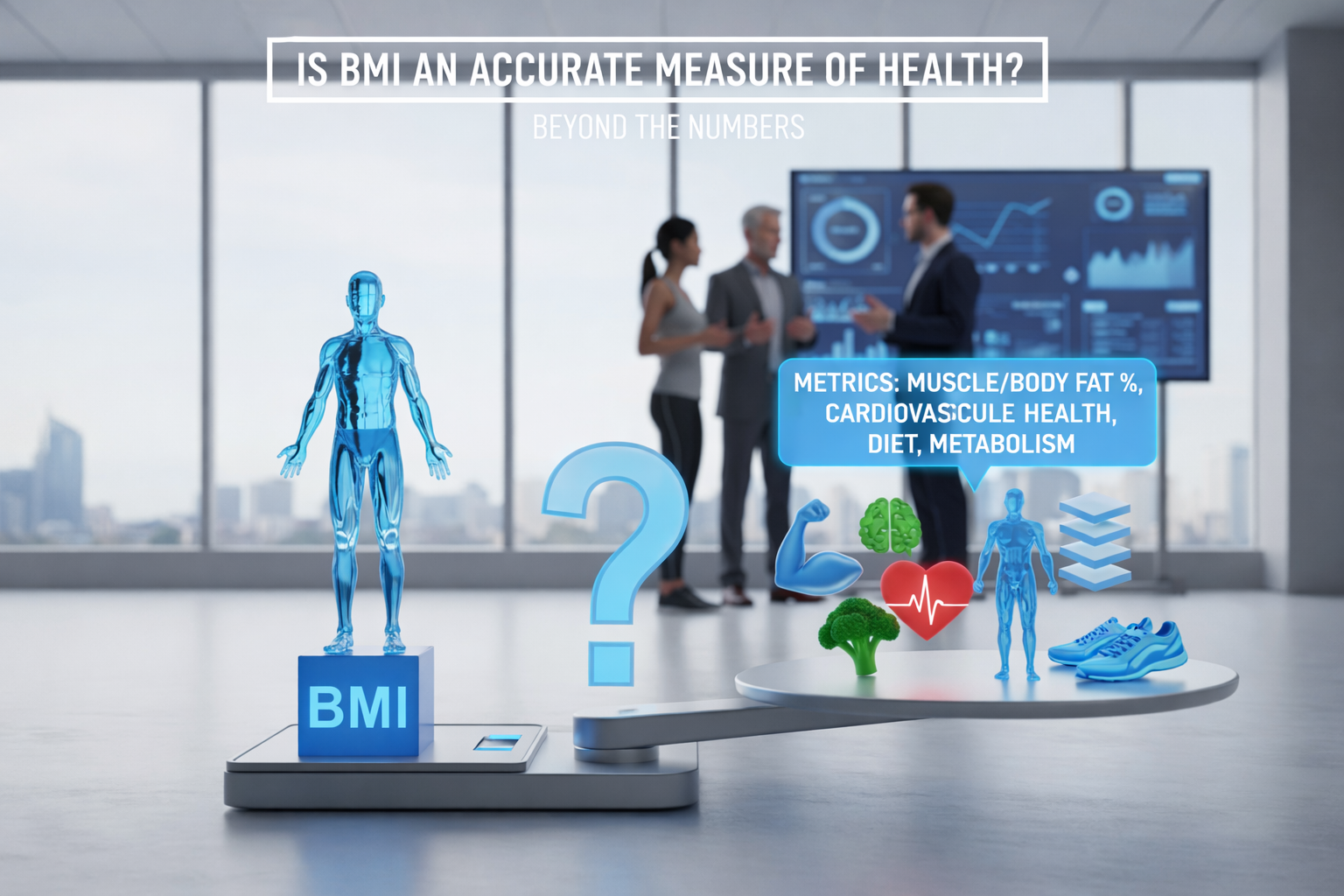
BMI, or Body Mass Index, is one of the most prevalent ways to check on someone’s health throughout the globe. BMI is a simple way for doctors, fitness coaches, insurance companies, and even smartphone health applications to tell whether someone is underweight, normal weight, overweight, or obese. and people often use online tools to check BMI. People like it because it’s easy to use, yet that same ease of use has generated severe problems.
As more individuals learn about holistic health, metabolic fitness, and tailored treatment, they are starting to wonder whether BMI really shows how healthy someone is. Can a single figure based on height and weight truly show how healthy someone is? This page goes into great detail on BMI, including where it came from, what its strengths and weaknesses are, what scientists think about it, and whether it should still be used as a health metric today.
What is BMI and How Can you Figure it Out?
To get a person’s BMI, you divide their weight in kilograms by the square of their height in meters. People are put into normal weight groups based on the number that comes out. Clinical settings and public health studies typically use these groups as examples.
The BMI method was meant to be a way to check the health of a group of people, not to diagnose them. The World Health Organization and other groups used BMI since it was straightforward to figure out, cheap, and could be used on a lot of people.
But just because something is easy to use doesn’t mean it’s accurate for everyone, which is where a lot of the criticism starts.
The Historical Roots of BMI
Adolphe Quetelet, a Belgian mathematician, came up with BMI in the 1800s. He didn’t want to look at each person’s health; he wanted to look at averages and social trends in the population as a whole. In the 20th century, health organizations started using Quetelet’s algorithm as the Body Mass Index.
This historical background is significant since BMI was never designed to diagnose illness, forecast longevity, or evaluate body composition. Over time, its initial function became less clear, and more and more people saw it as a clear sign of their own health.
Why BMI Became So Popular in Today’s Healthcare
BMI became popular because it gave people a consistent method to group body weight by population. Governments and healthcare systems required an easy way to keep track of obesity trends, figure out how dangerous they are to public health, and decide how to spend their money.
From an administrative point of view, BMI works well. It doesn’t need any specific tools, lab testing, or sophisticated training. This practicality is why BMI is still a part of medical standards, even though there is more and more evidence that it doesn’t work as well as it should.
The Main Idea Behind BMI
The basic idea behind BMI is that having a greater body weight for your height means you have more body fat and are consequently at a higher risk for health problems. This may be accurate in extensive population studies, but it often does not apply at the individual level.
The structure, muscle mass, bone density, fat distribution, and metabolic function of human bodies are all quite different from each other. BMI doesn’t take any of these factors into consideration, but it regards all weight as the same.
Does BMI Show How Much Fat You Have?
One of the biggest problems with BMI is that it doesn’t directly measure body fat. BMI can’t tell the difference between muscle, bone, organs, and water, which all add up to body weight.
According to BMI, an athlete with a lot of muscle may be considered overweight or obese, even if they have minimal body fat and good heart health. On the other hand, someone with a “normal” BMI may have too much visceral fat, which may be very bad for their health.
The Problem with Muscle Mass and BMI
Muscle has greater mass than fat, which means it weighs more by volume. People who do strength training, play sports, or have physically demanding employment sometimes have higher BMIs even when they are metabolically healthy.
This misinterpretation may cause people to worry too much, get bad medical advice, or try to lose weight in the wrong way. It may even stop people from doing beneficial things like strength training because they are afraid of “gaining weight.”
What It Misses About BMI and Fat Distribution
How much fat is in the body is important, but so is where it is stored. Visceral fat, which builds up around internal organs, is linked to heart disease, diabetes, and inflammation. Subcutaneous fat, which is stored beneath the skin, is usually less hazardous.
BMI doesn’t say anything about where the fat is in the body. Two people with the same BMI might have quite different health profiles based on where their fat is stored.
Weight vs. Metabolic Health
Weight alone does not determine health. Blood sugar control, cholesterol levels, blood pressure, inflammatory markers, and insulin sensitivity are all important signs of good metabolic health.
Studies indicate that some persons categorized as overweight by BMI are metabolically healthy, whilst others with a normal BMI exhibit evidence of metabolic dysfunction. This occurrence undermines the notion that BMI only determines health.
BMI at Different Ages
Age has a big impact on body composition. As individuals become older, their muscle mass usually goes down and their fat mass goes up, even if their weight stays the same. BMI does not take these changes that happen with aging into consideration.
A little higher BMI may be beneficial in older persons, but a low BMI is linked to frailty, compromised immunity, and an elevated risk of death. Using only one BMI norm for all ages makes complicated biological changes too simple.
Differences in BMI and Gender
Men and women have various physical types by nature. Women usually have more body fat than males, which is natural and necessary for hormones to work.
BMI doesn’t take these disparities into account, which might lead to healthy women being wrongly classified as overweight or men with low muscle mass and excessive visceral fat being wrongly thought to be at lower risk of health problems.
Variations in BMI Accuracy Based on Ethnicity and Genetics
The BMI cutoffs were mostly made using data from European populations. But body composition and fat distribution differ across ethnic groups because of genetic, cultural, and environmental influences.
For instance, people from South Asian origins may have metabolic disorders with lower BMIs, whereas certain African groups may have more muscle mass at the same BMI. Using universal BMI standards doesn’t take these important distinctions into account.
The Psychological Effects of BMI Labeling
Being called “overweight” or “obese” only because of your BMI might have mental effects. A focus on BMI too much may lead to weight stigma, anxiety, disordered eating, and poor self-esteem.
When BMI is the main thing that people think about, it might make other important health habits like getting enough sleep, eating a balanced diet, exercising, and managing stress less important.
BMI in Clinical Practice: Helpful But Not Enough
Even though it has problems, BMI may still be effective as a first step in screening. It helps spot patterns in the population and points out those who may need further evaluation.
But issues can up when BMI is used as a final diagnosis instead than a starting point. Responsible healthcare practice requires supplementary measures and contextual comprehension.
Other Health Indicators That Are More Important Than BMI
Health has several different parts. Waist circumference, waist-to-hip ratio, body fat percentage, cardiorespiratory fitness, and metabolic indicators are some of the things that might give you a better idea of your real health.
Lifestyle variables are also very important. Levels of physical activity, quality of nutrition, sleep habits, and chronic stress typically have a bigger effect on health than BMI alone.
Why BMI Is Still Around Even Though People Don’t Like It
BMI is still used since it’s easy to understand, well-known, and a big part of healthcare systems. To change standardized tools, institutions need to put in the work, update their training, and change their policies.
Although the medical profession is becoming more aware of BMI’s flaws, it is still a useful measure until other, more practical options are commonly used.
Is BMI Totally Useless?
BMI isn’t meaningless, but it’s not comprehensive either. It works really well for big groups of people and as a first test. When used to judge someone’s health without any other information, its flaws become apparent.
The main problem isn’t BMI itself; it’s how people use and understand it.
Do You Need to Worry About Your BMI?
People shouldn’t only look at their BMI; they should see it as one piece of information among several. Having a high or low BMI doesn’t imply you’re unhealthy, and having a “normal” BMI doesn’t mean you’re healthy either.
To get a whole picture of your health, you need to look at more than just your physical fitness, metabolic indicators, mental health, and daily behaviors.
The Future of Health Assessment After BMI
Modern health assessments are going toward measurements that are specific to each individual and that measure how well they work. Wearable gadgets, metabolic testing, and other technological advances are giving us more detailed information about our health.
As this change goes on, BMI may slowly lose its importance and be replaced with more personalized and precise measures of health.
Why It’s Important to Know More About Health Than BMI
If you want to learn more about health themes than just old figures, and you want information on wellness, nutrition, and current health research that is based on evidence and easy to read, sites like wideversa.com specialize on giving you knowledge that goes deeper than just numbers. By focusing on education instead of making things too simple, these materials help people make smart, long-term health choices instead of just going for arbitrary scores.
Conclusion
BMI is a useful tool, but just because it’s easy to use doesn’t mean it’s right. It is useful for big health evaluations, but not so much for individuals without further information. Health is complicated, always changing, and very personal. It’s too complicated to be boiled down to a single ratio.
Knowing what BMI can’t do helps people and doctors utilize it correctly, without letting it determine their health, self-worth, or medical choices.
FAQs
1. Is BMI a good measure for athletes?
BMI typically gets athletes wrong since it doesn’t take into consideration increased muscle mass, which makes you heavier without adding fat.
2. Is it possible to be healthy with a high BMI?
Yes, a lot of people with a higher BMI have normal metabolic indicators and excellent heart health.
3. Is it possible to be unwell even if your BMI is normal?
Yes, a normal BMI doesn’t mean you don’t have visceral fat, insulin resistance, or other metabolic problems.
4. Why do physicians still use BMI?
Doctors use BMI because it is a rapid, standardized way to screen a lot of people, not because it is a precise metric.
5. Does BMI tell you how much body fat you have?
No, BMI simply looks at height and weight. It doesn’t look at fat, muscle, or bone density.
6. Is BMI different for males and women?
The method is the same, but it doesn’t take into account the inherent variances in body composition between men and women.
7. Does aging have an effect on the accuracy of BMI?
Yes, BMI is less accurate as you get older since your muscle mass and fat distribution vary.
8. Are the BMI cutoffs the same in all countries?
BMI cutoffs are widely used yet fail to adequately represent health hazards for all ethnic groups.
9. Should you not pay any attention to BMI?
No, it shouldn’t be taken as a single sign of health. It should be used as a broad guide.
10. What is more important than BMI?
More than just BMI, your lifestyle, metabolic health, physical fitness, and mental wellness are all important.
Summary
BMI was meant to be a way to screen a whole population, not a full health check. It doesn’t check for body fat, muscle mass, fat distribution, metabolic health, or lifestyle variables. BMI is still important for seeing broad patterns, but it might be deceptive if you just use it. A more tailored and wide approach that looks at physical, metabolic, and mental health combined is needed for a true health evaluation.