

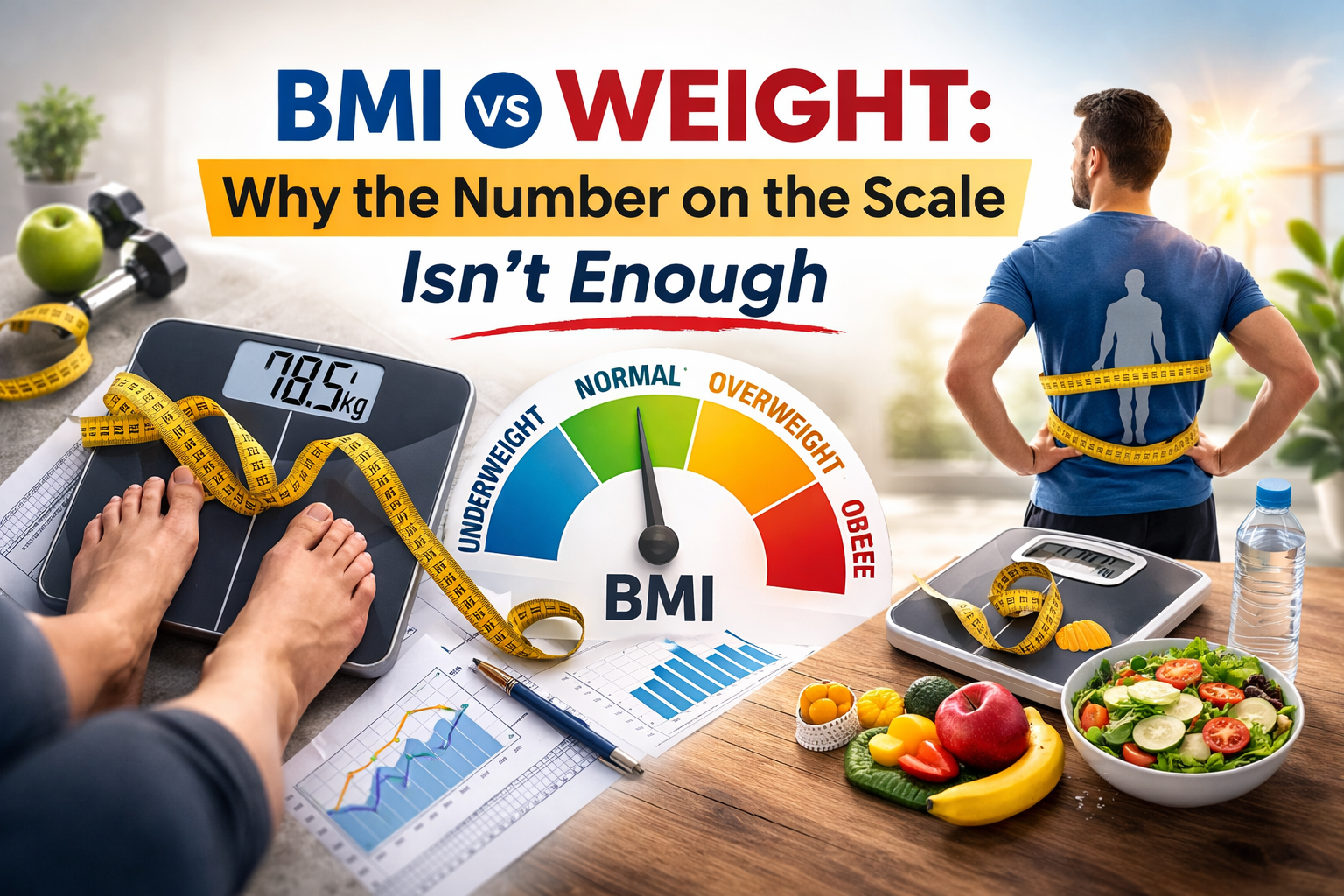
For a long time, people have thought that the bathroom scale was the best way to tell how healthy they were. You may step on it, see a number, and right away make a judgment about your physique, your habits, and even your value as a person. Body Mass Index (BMI) is now another widespread measure used by physicians, fitness coaches, and health apps to identify people as underweight, normal, overweight, or obese, along with weight.
But current health research is coming to a consensus on one thing: weight and BMI alone can’t tell you everything about your health. A single statistic can’t tell you everything about the human body. Relying just on these numbers might lead to wrong judgments, bad habits, and extra stress.
This article talks about the differences between BMI and weight, why people frequently get them wrong, what they don’t do well, and what really matters when judging health. By the end, you’ll know why the number on the scale isn’t enough and what you should focus on instead.
Understanding Body Weight Beyond the Scale
Body weight is just the overall weight of your body. It has bones, organs, water, and everything else that makes you who you are. Your weight might shift from day to day because of how much water you drink, how much salt you eat, hormonal fluctuations, stress, and even how well you sleep.
This implies that weight is not a reliable or accurate way to tell whether someone is healthy. A person may lose weight because they are sick or dehydrated, not because they are becoming fit. On the other hand, a person could gain weight because their muscles are becoming bigger, which makes them more healthier.
The issue emerges when weight is assessed devoid of context. It doesn’t explain what makes up that weight or how the body works when you look at it alone.
What is BMI and Why Was It Made?
The Body Mass Index (BMI) is a calculation that divides a person’s weight by the square of their height. It was first designed as a way to look at population-level statistics, not as a way to check on someone’s health.
BMI became popular because it is straightforward to use, cheap, and can be used on a lot of individuals. It was used by public health groups as a way to find patterns in obesity and undernutrition.
But simplicity has a price. BMI presupposes that weight and height are proportionate and that everyone has the same body composition. In fact, neither of these assumptions is valid.
Why People Often Mix Up BMI and Weight
A lot of people think that BMI is just a more “scientific” way to measure weight. Because of this misconception, BMI is now seen as a definite health score instead of a tentative estimate.
There is a set number for weight. BMI is a ratio. But neither of them can tell the difference between muscle and fat, take into account age or sex variations well enough, or look at how fat is spread throughout the body.
Because of this misconception, people have started to use BMI and weight interchangeably, which makes people think that lower numbers necessarily equal better health. That assumption is not only wrong, but it might also be detrimental.
The Biggest Problem: Body Composition
One of the biggest problems with BMI and weight is that they can’t tell you what your body is made of. Body composition is the amount of fat, muscle, bone, and water in the body.
Two people may weigh the same and have the same BMI, yet their health profiles might be quite different. One person may have a lot of muscle and not much fat, whereas the other may have a lot of visceral fat and not much muscle. Even when they have the same statistics, their metabolic health and risk of illness might be quite different.
Muscle is heavier than fat by volume because it is denser. This is why people who are physically active or athletic frequently have a BMI that puts them in the “overweight” or “obese” range, even when their heart health is great.
The way fat is spread out is more important than how much weight you have.
Not all fat on your body is the same. Visceral fat, which is found around internal organs, is far more harmful than subcutaneous fat, which is found just beneath the skin.
BMI and weight don’t tell you where fat is stored. Studies repeatedly demonstrate that extra abdominal fat is significantly associated with insulin resistance, cardiovascular disease, and inflammation, even in those with a “normal” BMI.
This indicates that a person might seem healthy based on their BMI even when they have a lot of inside fat, which greatly raises their chance of being sick.
How BMI Can Misclassify People Who Are Healthy
BMI often puts individuals in the wrong category, particularly those whose body shapes are not typical. People who have a lot of muscle, big bones, or genetically dense builds are typically called overweight even when they are metabolically healthy.
People with low muscle mass and high fat percentages, on the other hand, may have a “normal” BMI yet be at increased risk for chronic illness. This condition, which is frequently called “normal weight obesity,” shows how BMI may be deceiving.
Misclassification like this may stop people from doing good things or give them false hope, both of which are bad for their long-term health.
Psychological Effects of Health Focused on Scale
Putting too much focus on weight and BMI might hurt your mental health. Checking the scale all the time might make you feel anxious, guilty, and have bad connections with food and exercise.
People sometimes think that losing weight would make them feel better about themselves, which may lead to severe dieting, overtraining, or eating disorders. When weight reduction stops—often because the body is making natural adjustments—motivation declines, even if health signs are becoming better.
A health system that puts statistics ahead of well-being may overlook mental and emotional health, which are important parts of total health.
Why Losing Weight Doesn’t Always Mean Better Health
People frequently think that losing weight means being healthier, but that’s not necessarily the case. Rapid or rapid weight loss may cause muscle loss, hormonal changes, and not getting enough nutrients.
On the other hand, some people may gain weight while being stronger, more fit, and more mentally healthy. If weight is the only thing that matters, these good adjustments could not be noted or even be discouraged.
Often, health benefits happen within the body before they show up on the scale.
More Reliable Health Indicators Than BMI and Weight
Instead of just one statistic, using more than one indication gives a better picture of health. Some of them are metabolic indicators including blood sugar levels, cholesterol profiles, blood pressure, and markers of inflammation.
Strength, endurance, flexibility, and mobility are examples of physical performance measurements that might tell you about your functional health. Energy levels, sleep quality, digestion, and mood are further signs of how well the body is working.
When you look at all of these things together, they provide you a far clearer and more relevant picture of health than just weight or BMI.
What Lifestyle Has to Do with Long-term Health
Health is determined by everyday behaviors rather than fixed metrics. Nutrition quality, physical exercise, stress management, sleep consistency, and social relationships are all very important.
A person with a higher BMI who consumes foods that are rich in nutrients, exercises frequently, sleeps well, and controls stress may be far healthier than a person with a lower BMI who lives a sedentary, high-stress lifestyle.
When health is looked at as a whole, the emphasis changes from how you look to how well you work and how long you live.
Why a Personalized Health Assessment Is Important
Changes to food, exercise, and lifestyle affect each body in a distinct way. Genetics, age, hormone balance, and medical history all have an effect on health outcomes.
This is why tailored health evaluations work far better than broad measurements like BMI. Tailored methods let people concentrate on what really makes them feel better instead than chasing random numbers.
The Move Toward Holistic Health Thinking
Modern health discourse is gradually transitioning from weight-centric paradigms to more comprehensive and evidence-based methodologies. This change acknowledges that health is not a one-size-fits-all thing.
By adopting this viewpoint, people may set long-term health objectives that focus on strength, resilience, and quality of life instead of always losing weight.
Wideversa: A Better Way to Think About Your Health
If you want to learn more about health and go beyond old ways of measuring it, you need evidence-based platforms that concentrate on whole-person health. Resources that put education, sustainability, and real-world use first may help people stop focusing on how they look and start focusing on how they feel.
Wideversa.com has well-researched articles about health, fitness, and current wellness ideas that help people understand health beyond just statistics. Looking into these kinds of materials may be a big step toward being healthy in a smart, balanced, and long-lasting way.
Conclusion
BMI and weight might tell you a little bit about your health, but they are not the whole picture. When employed alone, they typically provide the wrong picture of body composition, don’t take into account metabolic health, and don’t take into account mental health.
Health is not just one thing. It shows how your body works, how you feel every day, and how long you can keep up your lifestyle. When you stop focusing on the scale, you may make space for healthy behaviors, a better self-image, and long-term success.
FAQs
1. Is BMI really useless?
BMI is not worthless, but it has its limits. It is best used to screen whole populations, not to diagnose individual health problems.
2. Is it possible for someone to be overweight and yet be healthy?
Yes. Health is not only about how big you are; it’s also about how well your body works, how you live your life, and how fit you are.
3. Why does my weight change even when I eat the same things?
Weight varies because of water retention, hormonal fluctuations, how much salt you eat, stress, and how you sleep.
4. Is it true that muscle weighs more than fat?
Muscle is heavier than fat for the same amount of area.
5. Should I quit weighing myself altogether?
Not always. Weight might be one piece of information, but it shouldn’t be the only or most important one when it comes to health.
6. Is having a normal BMI always good for you?
No. Some persons with a normal BMI may nonetheless have metabolic problems or a lot of visceral fat.
7. Which is more important: losing weight or losing fat?
Losing fat, particularly visceral fat, is far more essential for health than just losing weight.
8. How frequently should you check your BMI?
You don’t need to assess BMI very often. Long-term health patterns are more important than short-term alterations.
9. Can becoming in better shape make you gain weight?
Yes. Strength training and building muscle frequently make you gain weight, but they also make you healthier overall.
10. What is the finest sign of health?
There is no one best sign. Using a number of physical, metabolic, and behavioral indicators is the best way to judge health.
Summary
For a long time, people spoke a lot about weight and BMI when it came to health, but new data suggests that these are not enough on their own. They don’t take into consideration things like body composition, fat distribution, lifestyle, and mental health. If you just look at these figures, you might end up making the wrong health choices, becoming stressed out for no reason, and misclassifying yourself. A comprehensive strategy that emphasizes metabolic health, physical function, and long-term behaviors is a far better way to achieve lon