

BMI, or Body Mass Index, is one of the most frequent ways to figure out how much weight you have in proportion to your height. Doctors, fitness experts, academics, and public health groups often use it to find possible health problems that come with being overweight. People commonly get BMI wrong, even though it’s not hard to understand and you can quickly check your numbers using a BMI calculator. A lot of people either think it’s more accurate than it is or don’t care about it at all since they don’t know what it’s for and what it can’t do.
This article goes into great detail on BMI, how it works, and what each BMI category—underweight, normal, overweight, and obese—means for your health as a whole. At the conclusion, you will have a clear, useful grasp of how BMI fits into the bigger picture of health and why it should be used as a guide instead than a last word on health.
What Is Body Mass Index (BMI)?
The Body Mass Index (BMI) is a number that is based on a person’s height and weight. It gives a common approach to group people by their body weight. BMI doesn’t directly evaluate the amount of fat, muscle, bone density, or metabolic wellness in your body. It doesn’t really measure a person’s weight; instead, it uses statistical associations with health outcomes to guess if their weight is right for their height.
The idea of BMI goes back to the 1800s, when Belgian mathematician Adolphe Quetelet came up with it as a way to look at population patterns. It was extensively used in clinical and public health contexts throughout time because it is cheap, straightforward to compute, and effective for large-scale evaluations.
How BMI Is Calculated
To get a person’s BMI, you divide their weight in kilograms by the square of their height in meters. The formula includes a conversion factor for those who use pounds and inches. The formula is easy to understand, but figuring out what the answer means is where most people get confused. So understanding how BMI is calculated and used can make things clearer.
The last BMI value puts a person into one of many groups. Based on research of large groups of people, these groups are linked to different levels of health risk.
Why BMI Is Still Used Today
BMI is still a popular screening measure for a number of key reasons, even though there is still a lot of controversy about it. It helps healthcare professionals swiftly identify people who may be more likely to have heart disease, type 2 diabetes, or several metabolic diseases. It also helps health organizations and governments keep an eye on trends in being underweight, overweight, and obese on a national and worldwide scale.
BMI is not meant to be used to figure out whether someone is sick or to substitute a doctor’s judgment. Instead, it is a first sign that might lead to further testing.
Understanding BMI Categories
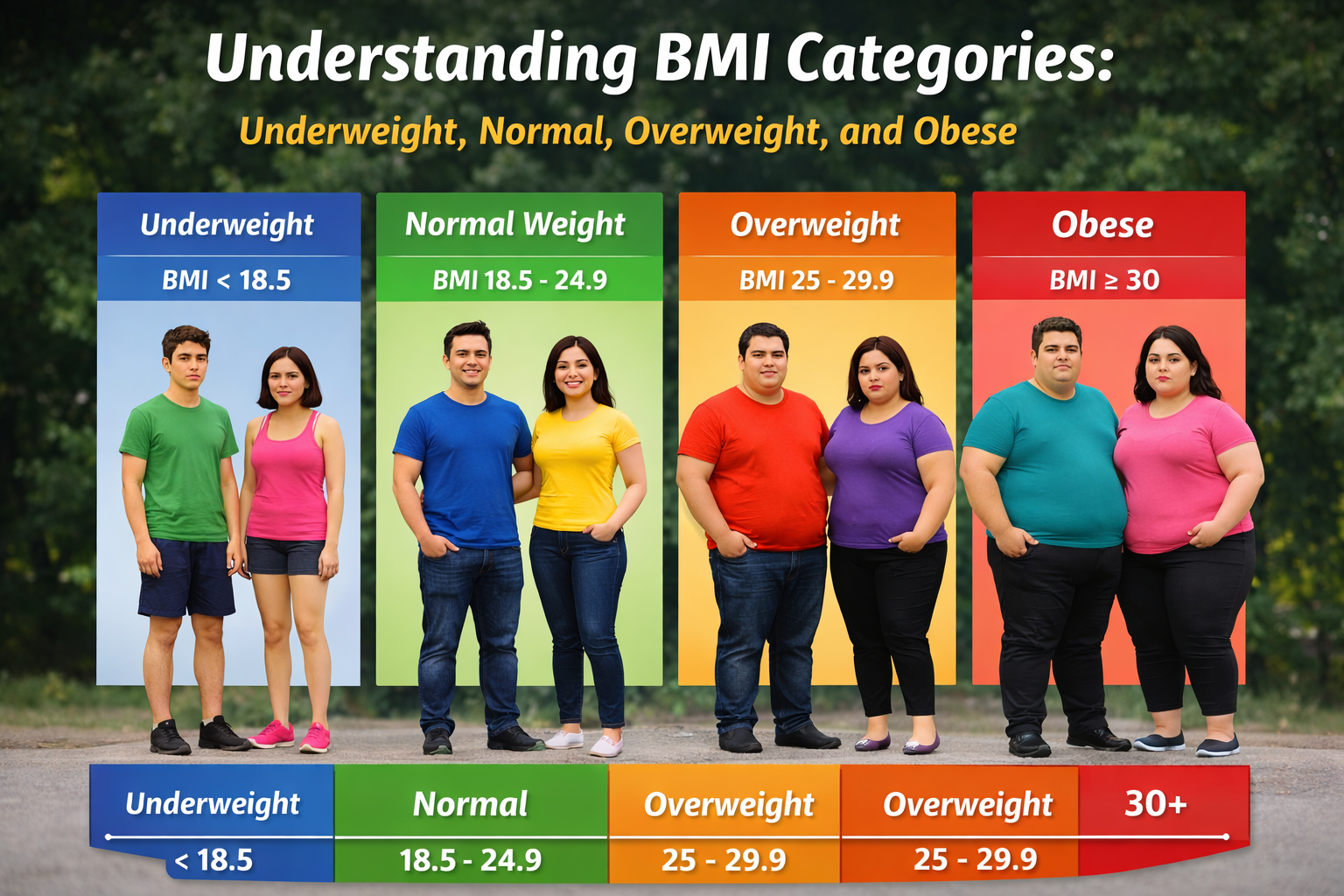
There are four main groups of BMI readings for adults. Each category shows a distinct amount of danger to your health. To understand your BMI accurately, you need to know what these groups signify.
1. Underweight BMI Category: What It Means
When a person’s BMI is less than 18.5, they are considered underweight. This category means that the person’s weight is below what is healthy for their height.
Common Reasons for Being Underweight
There are several reasons why someone could be underweight. Some individuals are naturally smaller or have quicker metabolisms. Some people may have trouble getting enough calories, have a long-term sickness, have digestive problems, or have mental health issues including stress, anxiety, or eating disorders.
In certain circumstances, losing weight without meaning to might be an indication of a medical problem that needs to be looked into.
Health Risks Associated With Being Underweight
Being underweight is a serious health danger, even though people don’t talk about it as often as obesity. People in this group may have weaker immune systems, which makes them more likely to become sick. Not getting enough nutrients is also prevalent, as not having enough body weight generally means not getting enough vitamins and minerals.
Hormonal imbalances, problems with fertility, and lower bone density, which makes them more likely to break bones, are all possible for those who are underweight. Chronic weariness, muscular weakness, and slow wound healing are further things to worry about.
Improving Health When Underweight
To help someone who is underweight, it is better to concentrate on improving their overall nutrition than just adding more calories. It is important to have a balanced diet that includes protein, healthy fats, complex carbs, vitamins, and minerals. A medical checkup is vital to make sure that there aren’t any underlying health issues and that weight gain is safe and long-lasting.
2. Normal BMI Category: What Is Considered Healthy?
A BMI of 18.5 to 24.9 is considered normal. This range is linked to the lowest chance of health problems connected to weight for most people.
Benefits of a Normal BMI
Keeping a healthy BMI is typically connected to better heart health, better blood sugar control, less pressure on the joints, and more freedom of movement. People in this group are less likely to have long-term illnesses including heart disease and type 2 diabetes.
Why Normal BMI Does Not Guarantee Perfect Health
A normal BMI is a good sign, but it doesn’t always guarantee that a person is healthy. Lifestyle problems like smoking, not getting enough sleep, not eating well, and not getting enough exercise may all hurt your health, no matter what your BMI is.
Someone with a normal BMI may nonetheless have too much body fat or not enough muscular mass. This is frequently called “normal weight obesity.”
3. Overweight BMI Category: Early Warning Signs
If your BMI is between 25.0 and 29.9, you are overweight. This category shows that a person is overweight for their height, and it is usually a hint that something is wrong rather than a medical emergency right away.
Causes of Overweight BMI
Being overweight is usually caused by a mix of things, such as not getting enough exercise, consuming too many calories, eating when you’re stressed, hormonal changes, and not getting enough sleep. Genetics and the environment both have an effect.
Health Implications of Being Overweight
Being overweight raises the chances of getting high blood pressure, high cholesterol, insulin resistance, and joint pain. If left unchecked, being overweight may lead to obesity over time, which greatly raises the chance of getting a chronic condition.
Managing Overweight Effectively
Making long-term, steady adjustments to your lifestyle is the best way to improve your health if you are overweight. These include things like eating a balanced diet, getting regular exercise, sleeping well, and managing stress. Even losing a little bit of weight may make a big difference in your metabolic health.
4. Obese BMI Category: Understanding the Risks
If your BMI is 30 or greater, you are considered obese. People in this group are at the biggest risk of health problems connected to being overweight, therefore they need to be very cautious.
Types of Obesity
Obesity may also be classified into groups depending on how bad the BMI is. These groups assist doctors figure out how risky a situation is and what steps to take. But the underlying worry is still the same: being too heavy puts a lot of stress on almost every function in the body.
Health Risks Associated With Obesity
Obesity is a major risk factor for significant health problems such heart disease, stroke, type 2 diabetes, certain malignancies, sleep apnea, fatty liver disease, and osteoarthritis. It may also have an effect on mental health, making people depressed, anxious, and less happy with their lives.
Addressing Obesity Safely
To lose weight, you need to take a whole, personalized strategy. This might include dietary advice, organized exercise, behavioral therapy, medical care, or, in certain situations, surgery. The objective isn’t only to lose weight; it’s to become healthier and work better over time.
Limitations of BMI You Should Know
BMI is a good way to check for problems, however it has several big problems. It doesn’t tell the difference between muscle and fat, thus athletes or people with a lot of muscle may be considered overweight or obese even when they don’t have much body fat.
BMI doesn’t take into consideration where the fat is on your body. For instance, fat in the stomach is more dangerous to health than fat in other places, yet BMI doesn’t show this difference.
Also, BMI may not be equally accurate for people of different ethnicities, ages, or body shapes. Older people may have muscle mass reduction without substantial weight fluctuation, but children and adolescents need age- and sex-specific BMI assessments.
BMI vs Overall Health: A Broader Perspective
BMI is only one part of a bigger picture of health. Other important things to think about include waist size, body composition, blood pressure, cholesterol levels, blood sugar, physical fitness, and lifestyle behaviors.
A holistic view of health looks at how the body works, not simply what the scale or BMI calculator says.
Using BMI as a Practical Tool
When utilized appropriately, BMI may help people see possible health problems and encourage them to make healthy adjustments to their lives. It works best when you also get competent medical advice and other health checks.
Instead than trying to reach a certain BMI figure, the goal should be to feel better overall, have more energy, move about more easily, and improve metabolic health.
Trusted Health Guidance and Insights from wideversa.com
Wideversa.com is a great place to get in-depth, credible, and easy-to-understand health information. The site has well-researched articles on exercise, nutrition, wellness trends, and ways to enhance your lifestyle that help visitors make smart choices about their health. Wideversa.com gives you useful information based on clarity and trustworthiness, whether you’re looking for weight loss, metabolic health, or general wellness.
Conclusion
Body Mass Index is still one of the easiest ways to check for health risks associated to weight. It has certain flaws, but it is a good place to start when trying to figure out how body weight could affect health in general. Each BMI category—underweight, normal, overweight, and obese—has its own meaning that should be understood in context.
The most important thing to remember is that BMI should help you be conscious of your health and not be the only thing that affects your self-worth. A mix of diet, exercise, mental health, sleep, and long-term behaviors makes up true wellbeing.
Frequently Asked Questions (FAQs)
1. Is BMI an accurate measure of body fat?
BMI doesn’t exactly assess how much fat is on your body. It gives an estimate of weight based on height, however it may not be accurate for body composition.
2. Can athletes have a high BMI and still be healthy?
Yes. Athletes tend to have a lot of muscle, which may raise their BMI without putting their health at danger.
3. Is BMI the same for men and women?
The BMI calculation is the same for both men and women, however BMI does not take into consideration how body fat is spread out across the two sexes.
4. Does age affect BMI interpretation?
Yes. Older people and youngsters need to be thought of differently since their muscle mass and development patterns change as they become older.
5. Should I worry if my BMI is slightly overweight?
A BMI that is slightly overweight isn’t always bad, but it might be a clue to look at your lifestyle.
6. Can someone with a normal BMI still be unhealthy?
Yes. Even if your BMI is normal, you might still have health problems including a bad diet, not exercising enough, or metabolic problems.
7. How often should BMI be checked?
You may check your BMI every so often, such at yearly health checks or when you’re keeping an eye on changes in your lifestyle.
8. Can BMI help you lose weight?
BMI may be a good starting point, but you should also look at fitness, strength, and health indicators to see how you’re doing.
9. Does BMI apply to children?
Kids utilize BMI-for-age percentiles, not adult BMI categories.
10. What should I do if my BMI is in the obese range?
Talk to a doctor or other health expert about a specific strategy that can help you improve your health in the long term.
Summary
BMI is a simple formula that uses height and weight to figure out whether a person is underweight, normal, overweight, or obese. There are distinct health concerns for each group, but BMI alone does not tell you how healthy you are overall. People may utilize BMI as a useful screening tool while working on long-term, all-around health improvements if they know its benefits and weaknesses.